
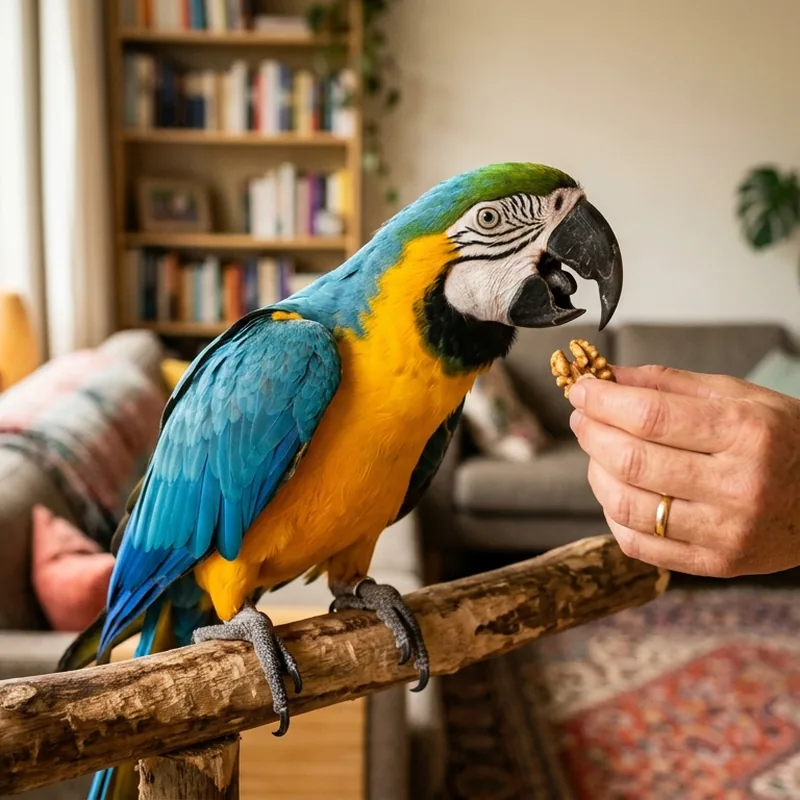
Parrots talk by mimicking human speech sounds, driven by their natural instinct to learn and reproduce the vocalizations of their social flock — in a home, that flock includes you. It’s a learned behavior built on real cognitive ability, not random noise, though most parrots don’t understand the meaning of words the way humans do.
Few things surprise new bird owners as much as hearing their parrot say something back for the first time — a clear “hello,” their own name, or an accidental phrase picked up from daily household chatter. It feels almost too human to be real, and it raises an obvious question: why do they actually do this?
The answer combines real neuroscience, evolutionary biology, and plain old social instinct. Parrots aren’t just randomly imitating sounds — they’re vocal learners with brain structures built specifically for this kind of complex sound reproduction, and understanding why makes the whole behavior even more impressive.
The Biology Behind Vocal Mimicry
Parrots belong to a small group of animals classified as vocal learners, a category that also includes songbirds, hummingbirds, dolphins, and elephants, but notably excludes most mammals, including dogs and cats, which cannot learn entirely new sounds the way parrots can. Vocal learning requires specific brain structures dedicated to hearing a sound, processing it, and then physically reproducing it through controlled vocal output — something most animals simply don’t have the neural wiring for.
Research on parrot brains has identified song-system-like structures similar to those found in songbirds, along with a unique secondary “shell” region around the core vocal-learning area that isn’t found in other vocal-learning birds. This extra structure is one theory researchers point to for why parrots are especially good at reproducing complex, varied sounds, including human speech specifically, compared to other vocal-learning species.
Why Would a Parrot Want to Mimic Humans at All?
In the wild, parrots are highly social flock animals, and vocal mimicry serves a real social purpose: recognizing and bonding with flock members, coordinating group movement, and reinforcing social bonds through shared calls. Wild parrots don’t mimic human speech, obviously, but they do mimic each other extensively, and even pick up environmental sounds within their habitat.
In a home, a pet parrot’s “flock” is effectively you and your household. Because parrots are instinctively driven to vocally bond with their social group, and their household group speaks human language constantly, mimicking that speech becomes a natural extension of the same flock-bonding instinct that would otherwise be directed at other parrots.
Do Parrots Actually Understand What They’re Saying?
This is one of the most common misconceptions to clear up: most parrot speech is genuine mimicry without full comprehension, similar to how a young child might repeat a phrase they’ve heard often without grasping its deeper meaning. A parrot saying “good morning” when the lights turn on has usually learned to associate that phrase with that specific moment, not necessarily understood the greeting’s meaning the way a person would.
That said, research on certain especially cognitively advanced parrots, most famously the African grey parrot studied by researcher Irene Pepperberg with a bird named Alex, has shown that some parrots can demonstrate genuine understanding of concepts like color, shape, and quantity when trained specifically for it, not just rote mimicry. This suggests parrot cognition is more sophisticated than simple mimicry in at least some cases, even though most pet parrots’ everyday talking remains largely associative rather than fully comprehending.
Which Parrot Species Talk Best?
Talking ability varies significantly by species, and it’s worth knowing before choosing a parrot specifically for this trait:
- African grey parrots are widely considered the most skilled talkers, known for both large vocabularies and, in some cases, contextual word use.
- Amazon parrots, particularly yellow-naped and double yellow-headed Amazons, are known for clear speech and can build sizeable vocabularies.
- Budgerigars (budgies), despite their small size, can develop surprisingly large vocabularies and are often underestimated as talkers.
- Cockatiels can talk but are generally better known for whistling and mimicking tunes than for clear speech.
- Macaws can talk, though generally with smaller vocabularies and less clarity than African greys or Amazons, often making up for it with loud, distinctive individual words.
Individual personality matters enormously within every species — some birds within a highly-talkative species never pick up more than a word or two, while others exceed expectations for their species entirely.
Do Parrots Mimic Other Sounds Besides Human Speech?
Absolutely, and often more readily than words. Household sounds like a phone ringing, a microwave beep, a doorbell, or another pet’s bark are all common targets for parrot mimicry, sometimes learned faster than actual words since they tend to be short, distinct, and frequently repeated. Some owners find their parrot has learned to imitate a smoke detector chirp or a laugh before ever saying a recognizable word.
This happens for the same underlying reason speech mimicry does — parrots are simply picking up and reproducing distinct, repeated sounds from their environment, and human words are just one category of sound among many they’re capable of learning.
Is a Parrot’s Talking Ability Linked to General Intelligence?
There’s a connection, but it’s not a perfect one-to-one measure. Species known for advanced talking ability, particularly African greys, also tend to score well on other cognitive tests involving problem-solving, object permanence, and basic reasoning, suggesting a genuine overlap between vocal learning capacity and broader intelligence in some species.
However, a parrot that doesn’t talk much isn’t necessarily less intelligent — cognitive ability and vocal mimicry inclination don’t always move together in every individual bird, and factors like personality, environment, and simple preference for other forms of expression all play a role independent of raw intelligence.
How Do Owners Actually Teach a Parrot to Talk?
Consistency and repetition are the foundation. Saying the same word or phrase in the same context repeatedly — like “hello” every time you enter the room — helps a parrot build the sound-to-context association that leads to spontaneous use. Positive, upbeat tone tends to work better than flat repetition, since parrots often pick up on and mimic the emotional inflection of speech along with the words themselves.
Young parrots, particularly during their first year, tend to be more receptive to learning new sounds, though older parrots can absolutely still learn new words throughout their lives — it just may take more patience. Talking to your parrot regularly during normal daily activity, not just in dedicated “training sessions,” is often just as effective, since it mirrors how the behavior would naturally develop from constant flock exposure.
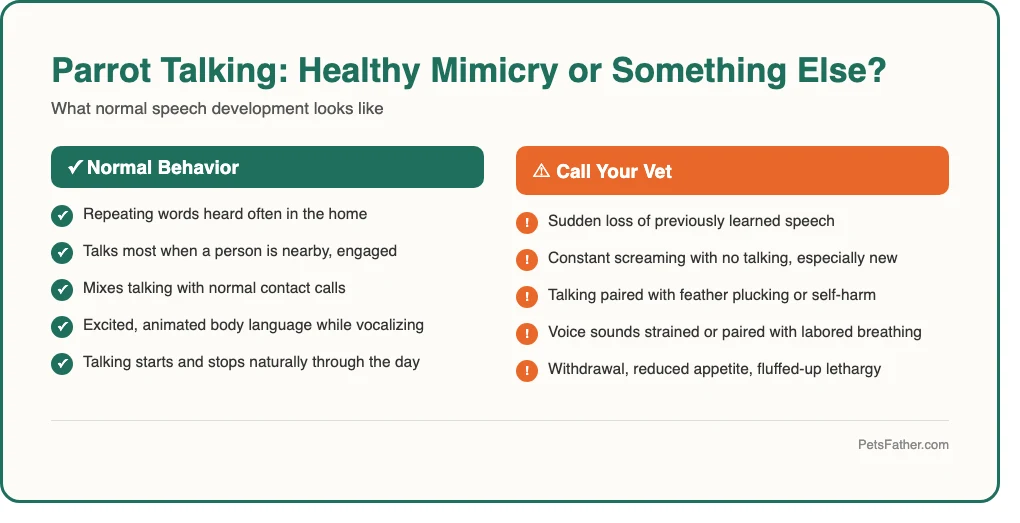
One more thing worth knowing: a sudden, unexplained increase in vocalizing or an equally sudden drop in talking from a normally chatty parrot can both be worth noting alongside other behavior. Parrots are sensitive to stress, illness, and environmental change, and vocal patterns sometimes shift as an early, subtle signal before more obvious symptoms appear — it is not usually cause for alarm on its own, but it is a reasonable detail to mention at a check-up if paired with anything else unusual.
Do All Parrots Eventually Learn to Talk?
No — plenty of parrots never learn to talk at all, and that doesn’t reflect anything negative about them as a pet or their intelligence. Some species are simply less inclined toward speech mimicry and communicate through other vocalizations, body language, and non-verbal social bonding just as effectively. Others may have the capacity but, due to personality, environment, or lack of consistent exposure, just never develop it.
If talking is a priority for you, researching species tendencies before choosing a parrot, and being realistic that even talkative species have individual birds who don’t talk much, will set more accurate expectations than assuming every parrot will eventually speak.
More Birds Guides
FAQ
Mostly not in the way humans do — most parrot speech is associative mimicry. Some highly studied individual parrots, most famously an African grey named Alex, have shown genuine understanding of certain concepts, but this isn't typical of everyday pet parrot talking.
African grey parrots are widely considered the most skilled talkers, both for vocabulary size and contextual word use, followed closely by certain Amazon parrot species.
Most parrot species are physically capable of vocal mimicry, but talking ability and inclination vary a lot by species and by individual bird — some parrots never talk regardless of species.
It varies widely, but many parrots begin attempting their first sounds or words within their first year, with talking ability generally continuing to develop with consistent exposure over time.
Parrots tend to pick up words and phrases said consistently and in a repeated context, like a greeting said every time you enter a room. Words heard less consistently or without a clear pattern are less likely to be picked up.
No — many parrots never talk and are perfectly happy, well-adjusted pets who communicate through body language and other vocalizations instead. Talking ability isn't a measure of a parrot's intelligence or wellbeing.
