
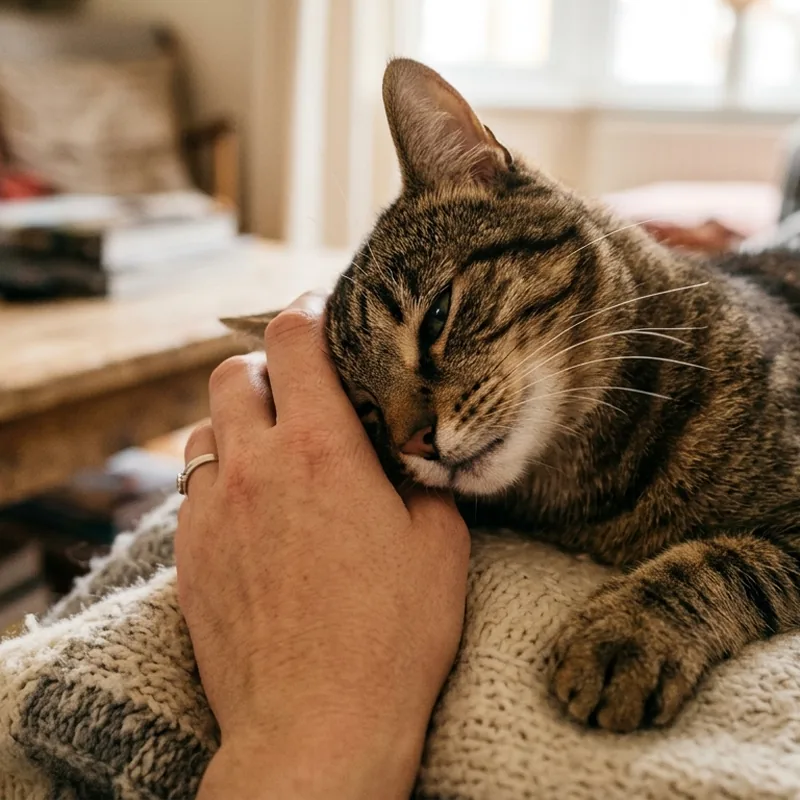
Cats headbutt you as a form of affectionate bonding called bunting — they’re rubbing their scent glands on you to mark you as part of their trusted territory. It’s one of the clearest signs of trust and affection a cat can show, not a behavior problem or a sign of aggression.
If your cat has ever walked up, pressed their forehead firmly into your hand, leg, or face, and then looked at you like they’ve just accomplished something important, you’ve experienced bunting. It’s one of the most endearing things cats do, and also one of the most misunderstood — plenty of owners wonder if it means their cat wants something, is annoyed, or is just being weird.
The short answer is that it’s almost always a good thing. Bunting is one of the clearest, most reliable signals of trust in cat body language, and understanding why it happens makes it even more meaningful when your cat does it.
What Bunting Actually Is
Cats have scent glands concentrated around their face — on the forehead, cheeks, and chin. When a cat headbutts you, they’re depositing pheromones from these glands onto you, essentially marking you with their scent. In the wild and among feral colonies, cats do this to each other and to objects in their territory to create a shared “colony scent” that signals safety and familiarity.
When a cat bunts a person, they’re doing the same thing: claiming you as part of their trusted circle. It’s a mutual, voluntary behavior — a cat won’t bunt someone or something they’re afraid of or unsure about, which is exactly why it means so much when they do it to you.
Is Bunting the Same as Rubbing Against Your Legs?
They’re related but not identical. Leg-rubbing (technically called allorubbing when done between two animals) uses scent glands along the body and tail, not just the face, and often happens when a cat wants something specific, like feeding time or attention. Headbutting specifically, using the forehead, tends to be a more deliberate, focused gesture of affection rather than a request.
Many cats do both in the same greeting: a headbutt followed by a full-body rub against your legs. Some cats favor one over the other depending on their personality — headbutting is generally considered the more “intimate” version of the two.
Why Do Some Cats Headbutt More Than Others?
Personality plays a real role here. Some cats are naturally more physically affectionate and will headbutt frequently, while others show trust in quieter ways, like sitting nearby or slow-blinking, without much physical contact at all. Breed can factor in too — some breeds known for being especially people-oriented, like Siamese or Ragdoll cats, tend to be more consistently physically affectionate as a group, though individual personality still varies a lot within any breed.
Cats who were well-socialized with humans as kittens, particularly between two and seven weeks old, also tend to be more comfortable with this kind of close physical contact as adults. A cat with a rougher start or less early handling may take longer to warm up to headbutting a new person, even if they’re generally a friendly cat.
Does Headbutting Ever Mean Something Is Wrong?
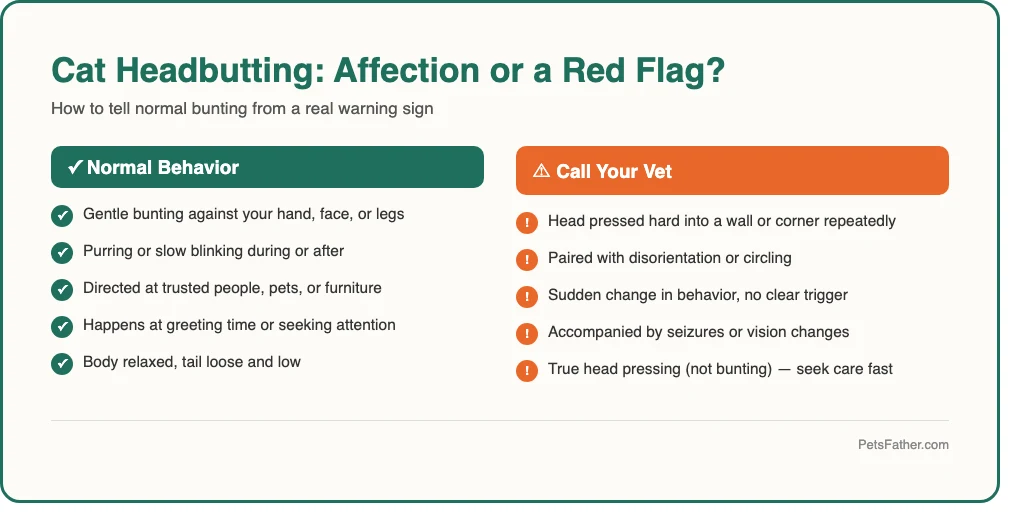
Not usually, but context matters. A gentle, relaxed headbutt paired with purring, a raised tail, or slow blinking is textbook affection. If a cat is headbutting unusually hard, repeatedly, combined with excessive vocalizing, or seems agitated rather than relaxed while doing it, it’s worth paying a bit more attention.
In rare cases, a sudden increase in head-pressing behavior that looks different from normal bunting — pressing the head against a wall or object for long periods, appearing disoriented, or seeming distressed rather than affectionate — can be a genuine neurological symptom unrelated to bunting entirely, and warrants a vet visit. This is a distinctly different behavior from a normal, relaxed headbutt greeting, and most owners will be able to tell the difference: normal bunting is brief, deliberate, and directed at a person or object your cat clearly likes.
Why Does My Cat Headbutt Furniture and Objects Too?
It’s not just people — cats regularly bunt doorframes, furniture corners, and even their own food bowls. This is the same scent-marking instinct at work, applied to their environment rather than a person. By depositing facial pheromones around the home, a cat builds a familiar scent map that helps them feel secure, which is part of why cats often seem calmer in spaces they’ve had time to mark this way.
This is also part of why a stressed or newly-moved cat may headbutt objects more than usual for a while — they’re actively re-establishing that sense of familiar territory in a new or changed environment. It usually settles down once the space feels established again.
How Does Headbutting Relate to Slow Blinking?
Slow blinking and headbutting often show up together and are frequently described as two dialects of the same underlying message: trust. A cat who headbutts you and then settles nearby with half-closed, slow-blinking eyes is showing a particularly strong combination of affectionate signals. Some owners even use a slow blink back at their cat — closing your eyes gently and reopening them slowly — as a way of returning the sentiment, and many cats respond well to it.
If you’re trying to build trust with a shy or new cat, combining a relaxed, unhurried presence with slow blinking (without forcing physical contact) is often a more effective first step than reaching out to pet them, and headbutting tends to follow naturally once that trust is established.
What Should I Do When My Cat Headbutts Me?
Lean into it. Gently headbutting or petting them back in the same spot they used, especially around the cheeks and forehead, reinforces the bond and often gets you an even more enthusiastic response next time. Most cats enjoy a light scratch under the chin or behind the ears right after a headbutt, since it’s the same general area they were just using to mark you.
Avoid grabbing or restraining a cat mid-headbutt even if it feels like an invitation for more contact — let them initiate and control the interaction, especially with cats who are still building trust with you.
One more small detail worth knowing: a cat headbutting you specifically on the cheek versus the top of the head can carry slightly different weight in some behaviorists’ observations, though both are affectionate — cheek-to-cheek contact is sometimes considered the more intimate of the two, closer to how cats greet trusted feline companions in a colony.
Can Kittens Headbutt Too, or Does It Develop Later?
Kittens can start showing bunting behavior quite young, often by a few weeks old, usually first directed at their mother and littermates before extending to humans. It’s a behavior that’s present from early development rather than something that only appears in adult cats, though how often an individual cat does it tends to become more consistent as their personality settles in adulthood, typically by one to two years old.
What About Cats Who Never Headbutt at All?
A cat who never headbutts isn’t necessarily less affectionate — they may simply express trust differently. Slow blinking, choosing to sleep near you, following you room to room, or bringing you a toy are all equally valid signs of a strong bond. Headbutting is one signal among several, not the only measure of how much a cat trusts someone.
If a cat who used to headbutt regularly suddenly stops entirely, especially alongside other behavior changes like hiding, appetite loss, or reduced grooming, that combination is worth mentioning to a vet, since it could reflect pain, stress, or illness rather than the headbutting itself being the issue.
More Cats Guides
FAQ
Yes — bunting is one of the clearest, most reliable trust signals in cat behavior. A cat won't do it to someone or something they're unsure about.
Some cats headbutt with real enthusiasm, especially larger or more physically affectionate cats. As long as your cat seems relaxed and happy rather than agitated, a firm headbutt is still just an enthusiastic version of the same affectionate behavior.
Most cats are capable of it, but frequency varies by individual personality, early socialization, and to some extent breed — people-oriented breeds like Siamese or Ragdolls tend to do it more consistently as a group.
Many owners gently press their forehead to their cat's or pet the same area their cat used to headbutt them — most cats enjoy this and it reinforces the bond, as long as your cat initiated the contact.
No — repeated pressing of the head against walls or furniture for long periods, especially if the cat seems disoriented, is a different and potentially serious neurological symptom, not affectionate bunting, and should be checked by a vet.
Kittens often start showing bunting behavior within the first few weeks of life, usually toward their mother and littermates first, well before it becomes a consistent adult behavior.
