
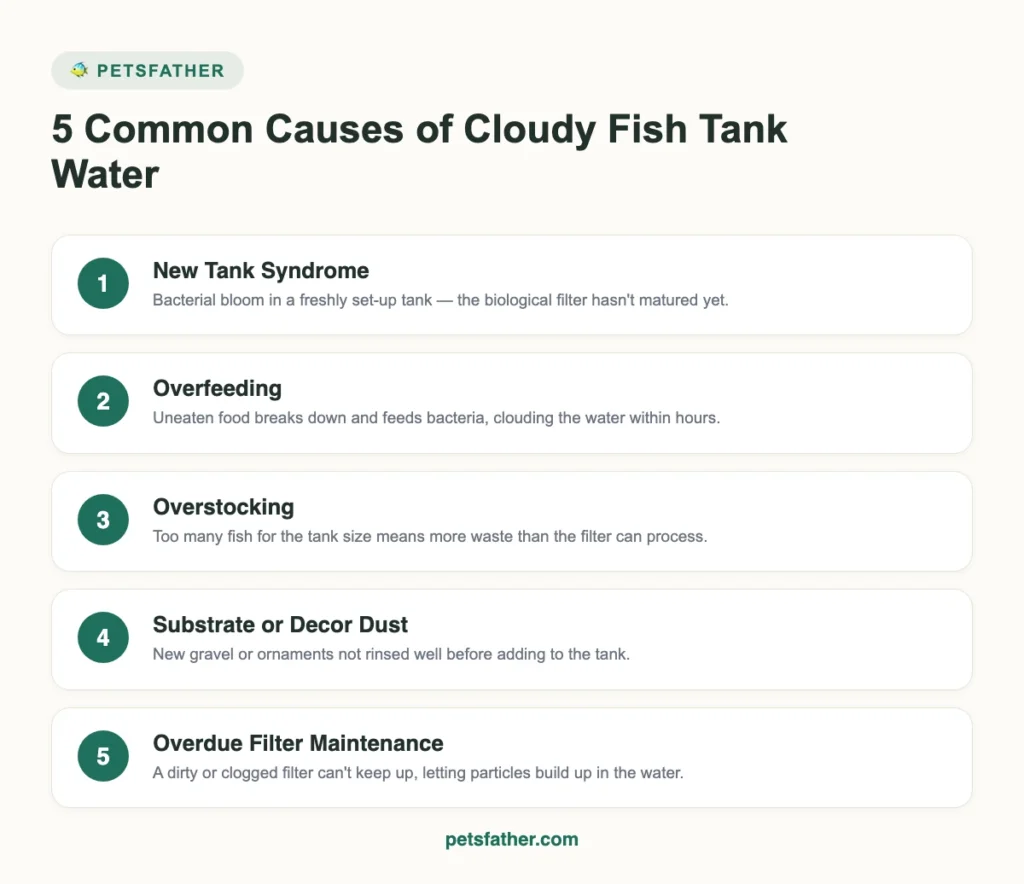
Cloudy fish tank water is almost always caused by a bacterial bloom, overfeeding, or a filter that isn’t keeping up — not by your fish themselves. The exact fix depends on which of those it is, and a quick look at your tank’s age and feeding habits usually points straight to the answer.
Cloudy aquarium water is one of those problems that looks alarming but is usually pretty simple to sort out once you know what you’re looking at. White or gray haze, a greenish tint, and a brownish murk are actually three different problems with three different fixes — so the first step is figuring out which kind of cloudy you’re dealing with.
White or Gray Cloudiness: Bacterial Bloom
This is the most common type, especially in tanks under six weeks old. It’s caused by a sudden spike in free-floating bacteria feeding on excess organic waste — ammonia, leftover food, or fish waste that built up faster than your filter’s beneficial bacteria could handle.
New tanks go through this almost every time. It’s part of a process called “cycling,” where beneficial bacteria colonies grow in your filter media to break down ammonia and nitrite. Until that colony is established, you’ll often see a hazy bloom for a few days to a couple of weeks. It usually clears on its own once the bacteria catch up — as long as you’re not making the problem worse with overfeeding in the meantime.
Green Cloudiness: Algae Bloom
If the haze has a green tint, that’s not bacteria — it’s a free-floating algae bloom, usually triggered by too much light or too many nutrients (often from overfeeding or infrequent water changes) feeding the algae. Direct sunlight hitting the tank for several hours a day is a common cause that’s easy to miss if the tank sits near a window.
Cutting back on lighting duration, adding a UV sterilizer, or doing more frequent partial water changes are the usual fixes here. A full water change won’t solve it long-term if the light and nutrient levels stay the same — the bloom will just come back.
Brown or Dusty Cloudiness: Substrate and Decor
This one’s simpler. New gravel, sand, or decorations that weren’t rinsed thoroughly before going into the tank will release fine dust that takes a while to settle or filter out. It’s harmless, but it can take a few days of running the filter to fully clear.
Is It Actually Dangerous for My Fish?
Cloudy water on its own usually isn’t an emergency, but it can be a visible symptom of an underlying water quality problem that is worth taking seriously — specifically an ammonia or nitrite spike. That’s the real thing to rule out first, and it only takes a basic liquid test kit to check.
If your test shows ammonia or nitrite above zero, that’s the priority to fix, not the cloudiness itself. Cloudy water paired with fish gasping at the surface, lying at the bottom, or showing red or inflamed gills is a sign to act quickly — a partial water change and a water test should be your first move.
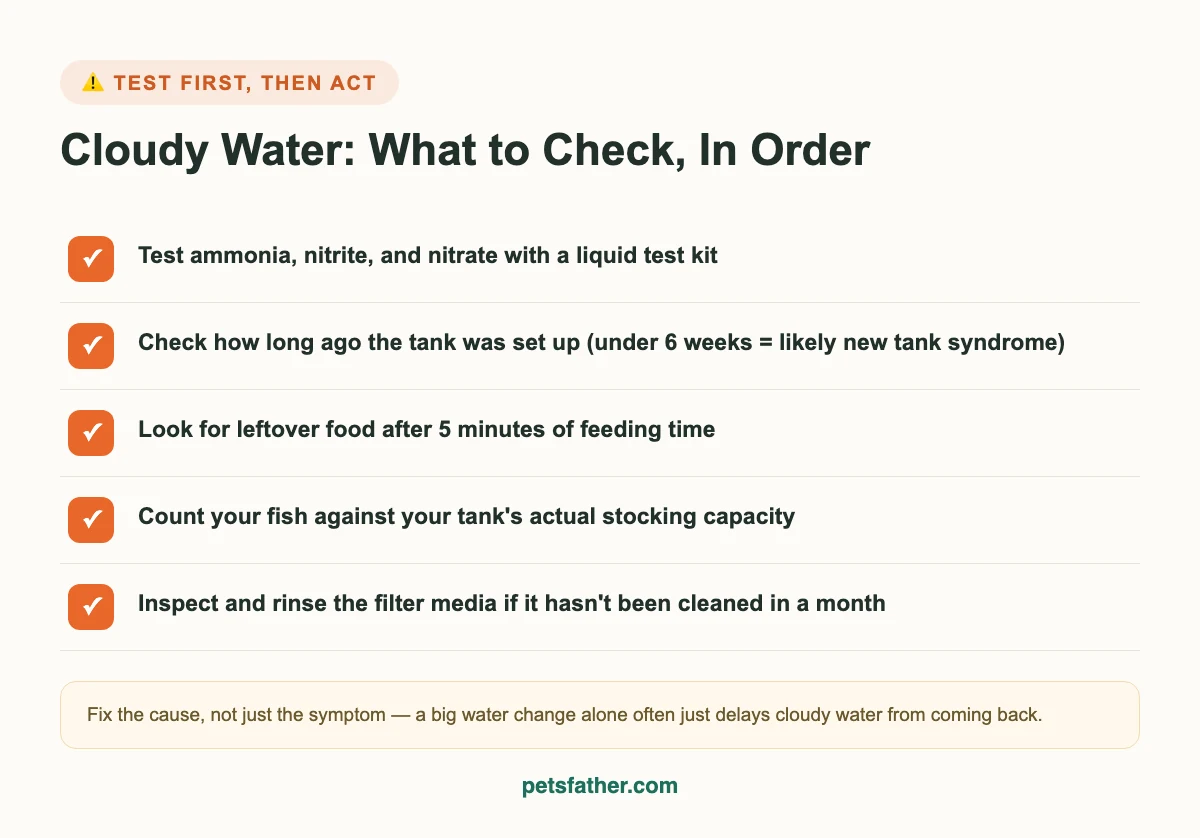
How to Actually Fix Cloudy Water
Once you know the cause, the fix is usually straightforward:
- Test your water first. Ammonia, nitrite, and nitrate levels tell you whether this is a new-tank bloom or an ongoing waste problem.
- Cut back on feeding. Feed only what your fish can finish in about two minutes, and remove anything left over after that.
- Check your stocking level. A tank with more fish than its filter can realistically support will struggle to stay clear no matter what else you do.
- Clean the filter, don’t replace it entirely. Rinse filter media in tank water (never tap water — chlorine kills the beneficial bacteria) rather than swapping it all out at once.
- Do a partial water change. 20-25% is usually enough to help without disrupting the tank’s overall bacterial balance.
- Be patient with new tanks. If the tank is under a month old and your ammonia/nitrite readings are trending down, the cloudiness is probably just the cycling process finishing up.
The mistake a lot of new fishkeepers make is doing a complete water change and a full filter clean at the same time, hoping to “reset” everything. That actually removes the beneficial bacteria you need to fix the problem long-term, and can make cloudy water worse before it gets better.
How Long Does Cloudy Water Usually Take to Clear?
A bacterial bloom in a new tank typically clears within a few days to two weeks once the tank finishes cycling. Dust from new substrate usually settles within a couple of days of filter running time. Algae blooms can take longer — often one to three weeks — since you’re addressing a lighting or nutrient issue rather than waiting out a natural process.
Cloudy Water vs. Other Water Problems
It’s easy to lump every water quality issue into “cloudy,” but a few related problems get confused with it and actually need different fixes:
- Foam or bubbles on the surface is usually a protein buildup from waste or excess food, not the same issue as haze in the water itself. A surface skimmer or increased surface agitation helps here.
- Yellow-tinted water often points to tannins from driftwood or old filter media that hasn’t been changed in a long time, not bacteria or algae.
- Oily film on the surface can come from overfeeding fatty foods or, less commonly, airborne contaminants like aerosol sprays used near the tank.
Each of these looks like “something’s off with my water” at a glance, but treating them as a generic cloudy-water problem won’t fix the actual cause.
Preventing Cloudy Water Going Forward
Once your tank is clear, a few habits keep it that way:
- Stick to a consistent feeding amount rather than guessing — measuring out food prevents the slow creep of overfeeding.
- Keep a regular water change schedule. Weekly or biweekly partial changes, depending on your stocking level, prevent waste from building up gradually.
- Rinse anything new before it goes in the tank — gravel, decorations, and plants all benefit from a quick rinse first.
- Don’t over-clean the filter. Rinse media in tank water occasionally rather than replacing all of it or scrubbing it completely clean, which resets your beneficial bacteria colony.
- Watch your tank’s light schedule. 6-8 hours of consistent lighting is usually enough — more than that, especially direct sunlight, invites algae blooms.
Common Mistakes That Make Cloudy Water Worse
A few well-meaning reactions actually slow down recovery instead of speeding it up:
- Panicking and doing a 100% water change. This strips out the beneficial bacteria that are actively working to fix the problem, effectively restarting the cycle.
- Adding more fish to “balance things out.” More fish means more waste, which is the opposite of what a struggling filter needs.
- Switching filter media entirely. New, unestablished media doesn’t have the bacterial colony the old media had, even if it looks cleaner.
- Ignoring it and hoping it clears on its own without testing water first. Sometimes it will, but skipping the test means you might miss an actual ammonia spike that needs addressing.
The pattern across all of these is the same: cloudy water is usually a symptom of an imbalance, and the fix is restoring balance gradually, not making a dramatic change all at once.
More Fish & Aquarium Guides
FAQ
Not usually on its own, but it can be a visible sign of an ammonia or nitrite spike, which is dangerous. Test your water to rule that out rather than assuming the cloudiness itself is harmless.
No — a full water change removes the beneficial bacteria your tank needs and can make the problem worse. A partial change of 20-25% is usually the better move.
Typically a few days to two weeks while the tank finishes cycling and beneficial bacteria establish themselves in the filter.
Yes, and it's one of the most common causes. Leftover food breaks down and feeds bacteria, which can cloud the water within a day or two of consistent overfeeding.
A UV sterilizer is effective against green, algae-caused cloudiness and some bacterial blooms, but it won't fix cloudiness caused by substrate dust or an overstocked tank.
Over-cleaning can actually be the cause if you're rinsing filter media in tap water or replacing it too often — that strips out the beneficial bacteria your tank relies on to stay clear.
Clarifiers can speed up clearing by clumping particles together for the filter to catch, but they don't address the underlying cause. If you don't fix the feeding, stocking, or maintenance issue behind it, the cloudiness tends to return.
Unconditioned tap water can occasionally cause a brief haze from dissolved minerals or chlorine reacting with tank contents, which is why using a dechlorinator during water changes is worth doing every time.
