
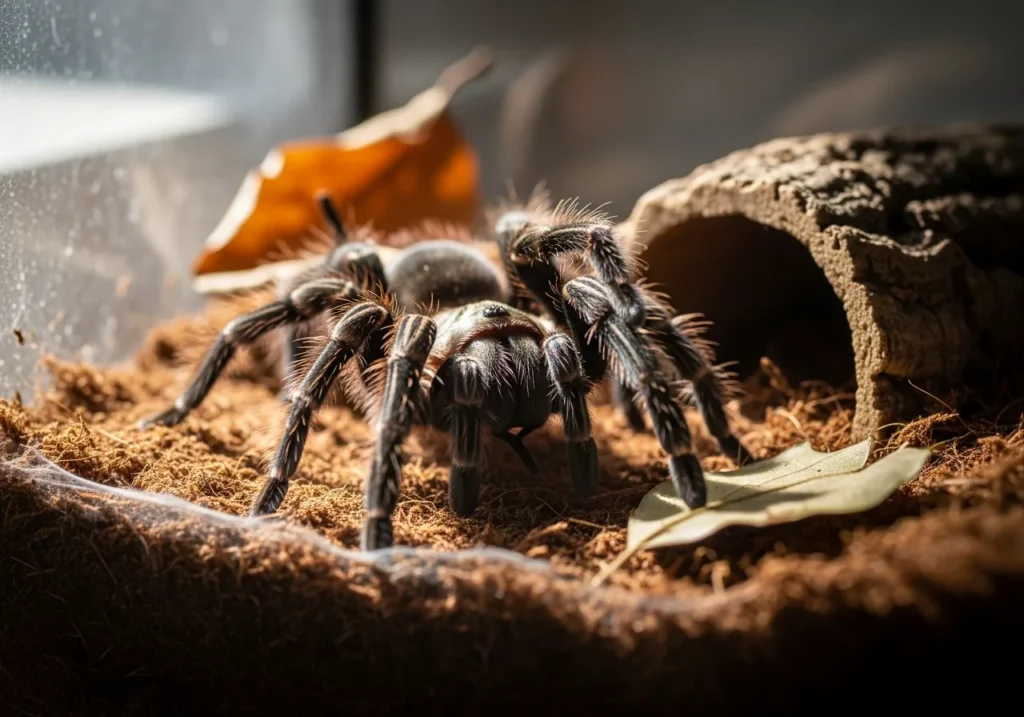
The clearest warning signs in a pet tarantula are curled, unresponsive legs, a leaking or discolored abdomen, or mites visibly covering the animal. Refusing food and slowing down, on their own, are usually just signs a molt is coming and aren't a concern.
The clearest warning signs in a pet tarantula are curled, unresponsive legs, a leaking or discolored abdomen, or mites visibly swarming the animal itself — these point to dehydration, injury, or infestation and deserve immediate attention.
What’s Actually Concerning
- Curled legs that don’t respond when the enclosure is gently disturbed — often signals severe dehydration or a failed molt.
- A leaking, discolored, or unusually shriveled abdomen — can mean injury, dehydration, or a ruptured abdomen from a fall.
- Mites covering the animal’s body, not just present in small numbers in the substrate — usually means the enclosure is too damp.
- No movement at all when gently prompted, combined with a sunken abdomen — a tarantula that’s genuinely unresponsive, versus one that’s simply resting (tarantulas can sit still for very long periods normally).
What’s Actually Normal (Not a Warning Sign)
Refusing food for days or weeks, reduced movement, and a dark bald patch on the abdomen almost always mean a molt is coming — this is completely normal and not a health concern on its own.
What to Do If You See a Real Warning Sign
Move the tarantula to a simpler enclosure with a shallow water dish nearby, keep handling to an absolute minimum, and reach out to an exotics-experienced vet or an established tarantula-keeping community for species-specific guidance — general vets often have limited invertebrate experience.
How Symptoms Combine to Change the Picture
A single mild sign in isolation — slightly reduced activity, for instance — is often nothing on its own. The same sign combined with a shriveled abdomen and curled leg tips paints a much more concerning picture. Evaluating symptoms together, rather than reacting to any single sign in isolation, gives a more accurate read on genuine severity.
Age-Related Changes That Aren’t Illness
Older tarantulas, particularly long-lived adult females, naturally slow down over the years — longer gaps between molts, generally reduced activity, and less frequent feeding are expected parts of aging rather than automatic signs of a problem, as long as body condition (a healthy, rounded abdomen) remains normal for that individual animal.
Documenting Changes Over Time
Keeping simple notes on molt dates, feeding response, and any unusual observations creates a personal baseline for your specific tarantula, making it far easier to distinguish an actual concerning change from normal individual variation — this is especially valuable for long-lived animals you’ll be observing for a decade or more.
Preparing for a Vet Visit
If you do need to consult an exotics vet, bringing clear photos or video of the concerning behavior, along with your notes on recent molt history and feeding pattern, gives the vet far more useful information than a verbal description alone — tarantula symptoms are often visual and can be hard to fully convey in words during a phone consultation.
The Value of Established Keeper Communities
Experienced keeper communities, while not a substitute for veterinary care in a genuine emergency, are often faster and more specifically knowledgeable than a general vet for distinguishing normal pre-molt behavior from an actual concern — many long-time keepers have seen the exact scenario you’re describing before and can help you judge urgency accurately.
Environmental Causes Behind Common Warning Signs
A significant share of “sick tarantula” concerns trace back to an enclosure issue rather than an illness in the animal itself — incorrect humidity, poor ventilation, or temperature swings can produce symptoms that look like illness but actually resolve once the underlying environmental cause is corrected. Reviewing recent enclosure conditions is a reasonable first step before assuming a health problem.
Distinguishing Defensive Behavior From Illness
A tarantula that’s unusually defensive — more prone to threat posturing or hair-kicking than usual — is often reacting to a recent disturbance or environmental stress rather than showing an illness symptom specifically. Context (a recent enclosure change, increased handling, new tankmates nearby) often explains a temperament shift better than assuming a medical cause.
Understanding the Limits of At-Home Diagnosis
Even experienced keepers can’t always distinguish every concerning sign from every normal variation with full confidence — this uncertainty is normal, and erring toward caution (adjusting husbandry, reaching out to a knowledgeable community, or consulting a vet for anything genuinely severe) is more appropriate than either dismissing every sign or panicking over every minor one.
Building Confidence to Trust Your Own Observations
New keepers often second-guess normal behavior more than experienced keepers, simply from lack of accumulated reference experience — this is completely normal early on, and cross-referencing with photos/descriptions from reliable sources, plus time spent observing your specific animal, steadily builds the confidence to correctly self-assess most situations without needing outside confirmation every time.
The Value of a Second Opinion for Uncertain Cases
When genuinely uncertain whether a sign warrants concern, getting a second opinion — from an experienced keeper community or, for anything serious, an actual exotics vet — is always a reasonable step, and shouldn’t feel like an overreaction even if the situation turns out to be normal behavior after all.
Learning From Past Experiences Over Time
Each molt cycle and each minor health scare you navigate with a specific animal adds to your working knowledge of that individual’s normal baseline — this accumulated, animal-specific experience is genuinely more valuable over time than any general guide, including this one, for judging what’s normal for your particular tarantula.
Creating a Personal Reference Log for Your Tarantula
Beyond simple molt and feeding dates, noting anything slightly unusual you observe — even things that turn out to be nothing — builds a more complete personal reference over time, useful both for your own pattern recognition and for giving a vet or experienced keeper community more complete information if you ever do need outside input.
Understanding the Limits of General Guides Like This One
General guidance on warning signs is genuinely useful as a starting framework, but it can’t replace species-specific knowledge and, more importantly, familiarity with your own individual animal’s normal baseline — treat guides like this as a foundation to build on with your own direct observation, not a complete, standalone diagnostic tool.
Preparing Mentally for the Long-Term Nature of Tarantula Keeping
Given the long lifespans involved, especially with female tarantulas, expect to navigate multiple molt cycles, occasional uncertainty, and gradual learning over what could be well over a decade of ownership — approaching this as an ongoing learning relationship with your animal, rather than expecting to master every aspect immediately, sets a more realistic and less stressful long-term expectation.
Final Perspective on Tarantula Health Monitoring
Most of tarantula keeping is genuinely uneventful — long stretches of normal behavior punctuated by occasional molts, with true emergencies being relatively rare in a well-set-up enclosure. Approaching health monitoring with calm, informed attentiveness rather than anxiety serves both you and your animal better over what’s likely to be a long-term relationship.
Telling a Molt Apart From a Genuine Tarantula Illness
A pre-molt tarantula and a sick tarantula can look alarmingly similar to a new owner, and mistaking one for the other leads to two opposite mistakes: panicking over a normal molt, or missing a real emergency because it was dismissed as “probably just molting.” The clearest distinguishing sign is the abdomen — before a molt, it typically appears larger, darker, and sometimes shiny or bald-looking as the old skin separates underneath, while the animal itself becomes reclusive and stops eating for what can be several weeks in adult specimens. This is normal and doesn’t call for intervention beyond maintaining stable humidity.
What should prompt concern instead is asymmetric leg positioning that doesn’t resolve, visible fluid or discoloration at leg joints unrelated to a molt in progress, a curled-under posture combined with lethargy that persists for more than a few days without any of the typical pre-molt abdominal changes, or refusal to right itself when gently flipped. A tarantula that’s simply pre-molt will still respond to gentle stimulus, even if sluggishly; one that’s genuinely ill or has failed a molt often won’t, and that lack of response is the more reliable warning sign than appearance alone.
More Insects & Invertebrates Guides
FAQ
Curled, unresponsive legs, a leaking or discolored abdomen, and mites visibly covering the animal are the clearest red flags, usually pointing to dehydration, injury, or infestation.
Yes — tarantulas are naturally low-activity animals and can sit motionless for very long stretches without anything being wrong. The concern is specifically an animal that stays unresponsive even when the enclosure is gently disturbed, combined with other signs like a sunken abdomen.
Not necessarily — tarantulas commonly refuse food before a molt or during natural fasting periods, which is normal and different from illness-related appetite loss.
