
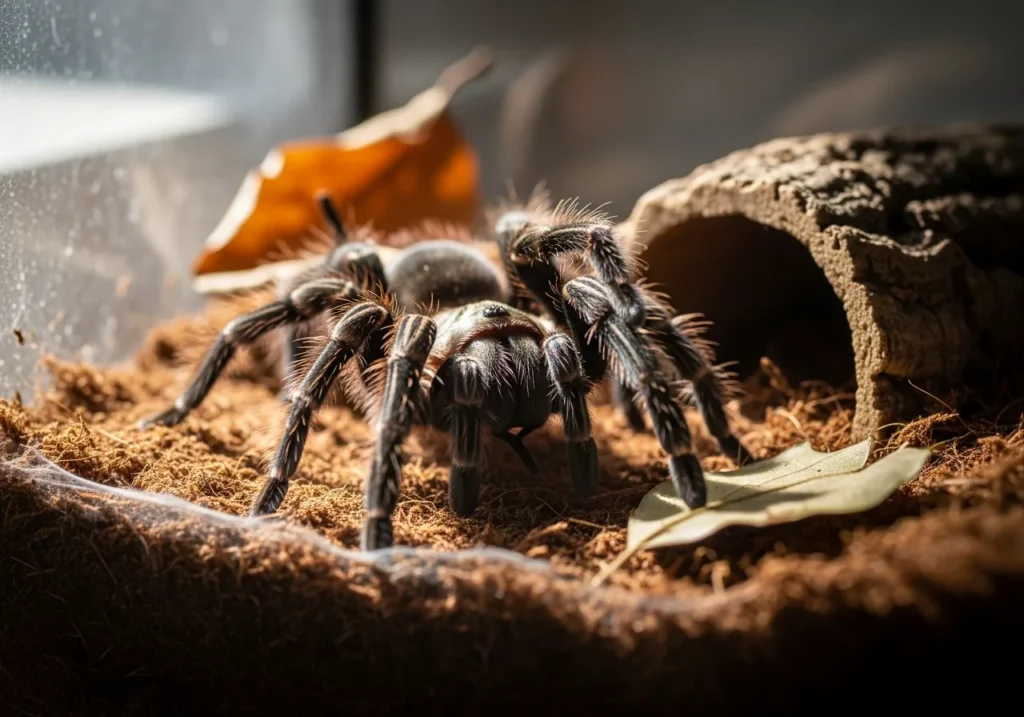
New invertebrate keepers should check substrate moisture and remove uneaten food weekly, inspect enclosure ventilation monthly, and always quarantine new animals for several weeks before introducing them to an existing collection.
New to invertebrate keeping? This checklist covers the basics that catch most first-time owners off guard.
Weekly Checks
- Confirm substrate moisture matches your species’ needs — not just “looks damp,” but actually checked with a hygrometer.
- Remove any uneaten prey or spoiled fresh food to prevent mold and mite buildup.
- Check the water dish is clean and full for species that use one.
Monthly Checks
- Inspect the enclosure lid and ventilation for wear — tarantulas especially can push at weak points over time.
- Review growth or activity against what’s typical for the species, and note any molts.
Before Adding a New Animal
- Set up a separate quarantine enclosure for several weeks before introducing a new invertebrate near an existing collection.
- Research the specific species’ care sheet — don’t assume “similar” species have identical needs.
Red Flags to Watch For
Curled legs, mites covering the body, mold combined with lethargy, or a discolored abdomen — see our full health guide for what each of these actually means and what to do about it.
Setting Up a Sustainable Care Routine
The checklist items matter less as a one-time task and more as a repeatable weekly and monthly habit — keepers who build these checks into a consistent routine (tied to a specific day of the week, for example) catch problems earlier than keepers who check only when something already seems off.
Tracking Multiple Animals Without Losing Detail
Once you’re managing more than one or two invertebrates, a simple written or digital log — enclosure, last feeding date, last molt date, last full substrate change — prevents the mixed-up memory that becomes likely once you’re juggling several animals with different individual schedules.
Seasonal Adjustments to Your Checklist
Home heating and cooling cycles shift ambient humidity and temperature meaningfully across seasons, even for enclosures kept in a consistent room — a checklist that includes a seasonal recalibration of your thermometer/hygrometer readings against your species’ actual needs catches drift that a “set it and forget it” approach misses.
What a Genuinely Thriving Enclosure Looks Like Over Time
Beyond avoiding red flags, a genuinely well-maintained enclosure shows signs of active thriving — steady, expected growth between molts, consistent feeding response outside of pre-molt periods, and (for bioactive setups) a visibly active cleanup crew. Checking for positive signs, not just the absence of problems, gives a fuller picture of overall enclosure health.
When to Escalate Beyond Routine Checks
If routine checks reveal a pattern rather than a one-off anomaly — repeated mold despite corrected humidity, or consistent feeding refusal well outside a normal pre-molt window — it’s worth escalating to a deeper husbandry review or an exotics vet consultation rather than continuing to apply the same routine checklist without change.
Adapting the Checklist for Different Species Groups
A checklist built around a predatory tarantula doesn’t map perfectly onto an isopod colony or a stick insect — predatory species checks focus more on individual feeding response, while colony species (isopods) focus more on population health and reproduction signs. Adjusting your specific checklist to match what you’re actually keeping gives more useful information than a generic one-size-fits-all version.
Using the Checklist During Vacations or Absences
A written checklist becomes especially valuable when handing care over to a pet-sitter during travel — it translates routine knowledge you’ve built up over time into clear, actionable instructions someone unfamiliar with invertebrate care can actually follow correctly.
Checklist Items Specific to Multi-Enclosure Households
Cross-contamination prevention — using separate tools or washing hands between enclosures, especially after handling a new or quarantined animal — belongs on the checklist once you’re managing more than one enclosure, since it’s an easy step to overlook that meaningfully reduces the risk of spreading mites or parasites between animals.
Digital Tools for Tracking Enclosure Checks
Simple spreadsheet templates or dedicated reptile/invertebrate keeping apps can automate reminders for weekly and monthly checks, which helps consistency far more than relying on memory, especially once you’re managing several enclosures with different check schedules.
Checklist Adaptations for Bioactive vs. Simple Enclosures
Bioactive enclosures need an additional check most simple setups don’t — cleanup crew population visibility and activity — since a struggling or collapsed cleanup crew population undermines the entire bioactive system’s waste management function without necessarily showing an obvious external sign right away.
Building Checklist Habits That Actually Stick
Tying enclosure checks to an existing habit — right after a regular weekly task you already do consistently — makes the new habit far more likely to stick than an isolated reminder disconnected from your existing routine.
Checklist Confidence Building Over Your First Year
The specific checklist items that feel effortful in month one typically become fast, automatic habits by month six or so with consistent practice — expecting this early-period effort to ease over time, rather than assuming ongoing care will always take as much conscious attention as it does at first, sets more realistic expectations for new keepers.
Checklist Modifications for Seasonal Molt Patterns
Some species show seasonal molting patterns even indoors, meaning certain checklist items (feeding response review, in particular) may need seasonal recalibration of what counts as “normal” for that time of year, rather than applying one fixed year-round expectation.
Sharing Checklist Responsibility in Multi-Person Households
When more than one household member shares invertebrate care duties, a written, agreed-upon checklist prevents the common failure mode where each person assumes the other has handled a specific task — worth formalizing even in a small household, once more than one person is involved in care.
Checklist Confidence for Keepers Managing Diverse Species
Keepers with a mixed collection — a tarantula, an isopod colony, and stick insects, for example — need genuinely separate checklists for each, since the specific weekly and monthly items differ meaningfully across these very different care types. Resist the temptation to create one generic combined checklist that doesn’t capture each animal type’s actual specific needs.
Using This Checklist as a Foundation, Not a Ceiling
As you gain experience with your specific animals, you’ll likely identify additional species-specific or individual-specific checks worth adding beyond this general framework — treat this checklist as a solid starting foundation to build on with your own observations over time, not a complete, unchangeable final list.
Distinguishing Molting From Illness in Invertebrates
Because invertebrates molt periodically throughout their lives, many owners misread a completely normal pre-molt period as a health emergency — and, less often, miss a real illness because it superficially resembles molting. In the days before a molt, most species stop eating, become noticeably less active, and may develop a duller or darker coloration as the old exoskeleton separates from the new one underneath; a tarantula’s abdomen often looks unusually dark or bald just before molting begins. This is normal and doesn’t require intervention — the main risk during this period is disturbance, since handling or even moving the enclosure can interrupt the process at a dangerous stage.
What separates a true health problem from a pre-molt period is the presence of additional symptoms: fluid leaking from joints, an inability to right itself if flipped, visible mold or mites concentrated at one site, or a molt attempt that appears to have stalled partway through for more than 24 hours. A successful molt should complete within a few hours to overnight depending on the species and its size; a partially-shed exoskeleton left stuck for a full day or more is a genuine emergency, not a slow-but-normal process, and calls for immediate humidity adjustment and, if it doesn’t resolve, an exotics vet consult.
Setting Up a Simple Observation Log
A written observation log, even a very simple one, catches health trends in invertebrates that memory alone tends to miss, since day-to-day changes are often too gradual to notice without a written record to compare against. A basic log doesn’t need to be elaborate — a notebook or phone note with a weekly entry covering appetite, activity level, and any visible changes is enough to establish a useful baseline within just a few weeks.
The real value shows up months later, when a subtle shift — a molt cycle running longer than previous ones, a gradual decline in feeding response, or a color change that’s easy to dismiss as normal variation in the moment — becomes obvious once it’s compared against several prior entries rather than judged against a vague memory of “how they usually seem.” For anyone keeping multiple invertebrates, a simple shared log format across all enclosures also makes it much easier to catch patterns that might indicate an environmental issue (like a humidity problem) affecting more than one animal at once, rather than an individual health issue.
More Insects & Invertebrates Guides
FAQ
Substrate moisture (checked with a hygrometer, not just by eye), removal of any uneaten prey or spoiled food, and a clean water dish where applicable — these three habits prevent most common problems before they start.
Yes — keeping a new arrival in a separate enclosure for several weeks is the single best habit for preventing mites or parasites from spreading through an existing collection.
Signs include reduced appetite, a dulled or darkened appearance, and reduced activity — all normal pre-molt behavior, not necessarily illness.
