
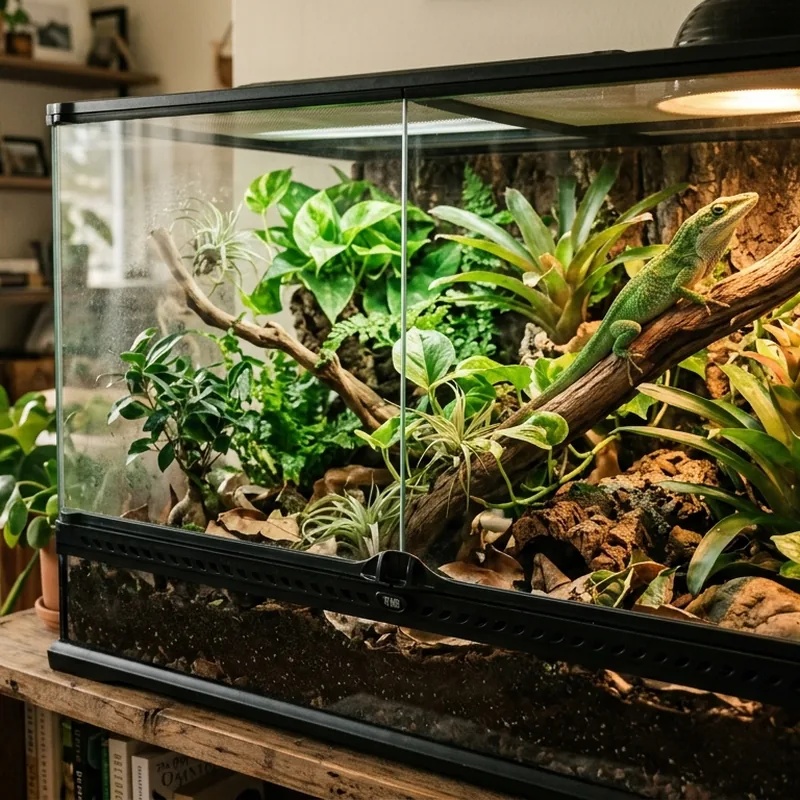
Start With Adult Size, Not Current Size
The single most common mistake is building or buying an enclosure sized for a young reptile rather than the adult it will grow into. Research your specific species’ full adult size before finalizing dimensions — many reptiles sold small at pet stores grow considerably larger than new owners expect.
Choosing a Material
Glass terrariums offer the best visibility and are widely available in standard sizes, but can be harder to maintain high humidity in for species that need it. PVC and wood enclosures generally hold humidity and heat better and insulate more efficiently, which matters more for tropical species than for arid-adapted ones.
Building the Thermal Gradient
Nearly all reptiles need a temperature gradient — a warmer basking area on one end and a cooler zone on the other — so they can move between the two to regulate their own body temperature. A basking bulb or heat lamp on one side, paired with a thermometer at both ends to actually verify the range, is the standard setup rather than guessing based on the bulb’s wattage alone.
Lighting Needs
Most diurnal reptiles need UVB lighting to properly process calcium and avoid metabolic bone disease, a serious and common problem in reptiles kept without it. Check your specific species’ UVB requirements, since needs vary meaningfully between, for example, a desert-dwelling bearded dragon and a nocturnal gecko.
Substrate and Humidity
Substrate choice should match your species’ natural humidity needs — arid-species substrates that dry out quickly for desert reptiles, versus moisture-retaining substrates like coconut fiber for tropical or humidity-dependent species. Getting this mismatched is a common cause of shedding problems and respiratory issues.
FAQ
Most diurnal (day-active) reptiles do, while some nocturnal species have lower or different requirements. Research your specific species rather than assuming one lighting setup fits all reptiles.
Use separate thermometers at the warm and cool ends rather than trusting the bulb wattage alone — actual measured temperature is the only reliable way to confirm the gradient is correct.
It depends on the species — glass offers better visibility, while PVC or wood typically retains heat and humidity more efficiently, which matters more for tropical species.
Building or buying an enclosure sized for the reptile's current juvenile size rather than researching and planning for its full adult size.
