
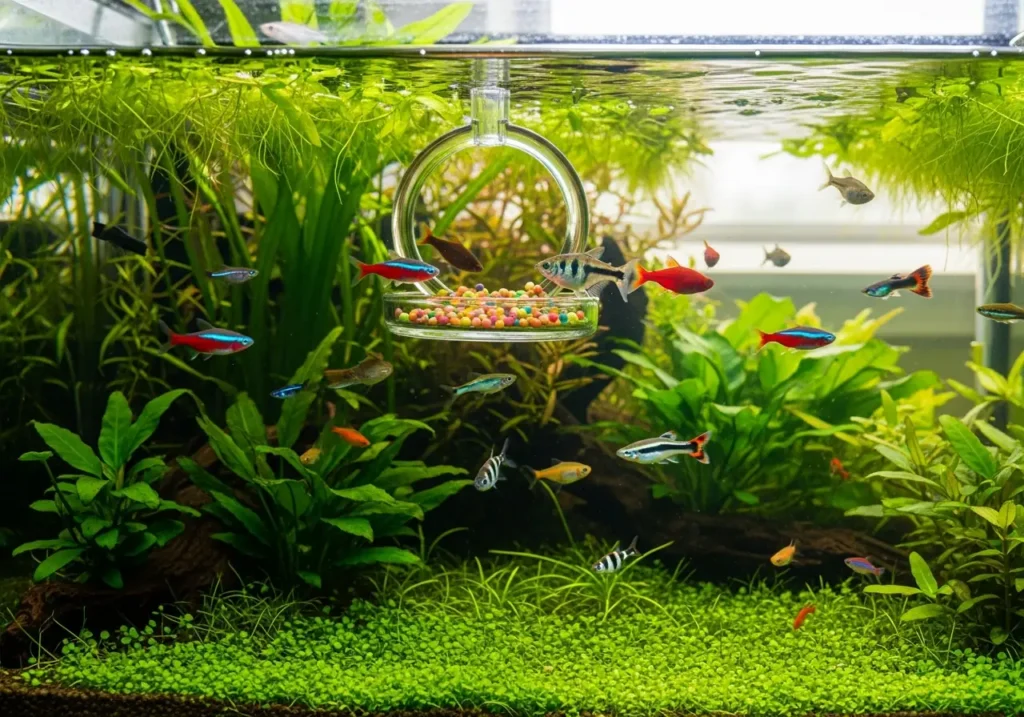
Feed aquarium fish once or twice daily, only as much as they can eat within two minutes. Consistently overfeeding is the leading cause of ammonia spikes and cloudy water in home aquariums.
Feed aquarium fish once or twice daily, only as much as they can eat within two minutes. Consistently overfeeding is the leading cause of ammonia spikes and cloudy water in home aquariums.
Why “As Much As They Can Eat” Beats a Fixed Amount
Every tank and every fish is different — a rule based on time (two minutes) adapts naturally to your specific fish, while a fixed pinch amount often overshoots for smaller tanks.
Signs You’re Overfeeding
Food sinking uneaten to the substrate, cloudy water within a day of feeding, and rising ammonia or nitrite readings all point to too much food, not too little.
Adjusting for Species
Bottom feeders like corydoras need sinking food specifically for them, since surface feeders often eat everything before it reaches the bottom.
Fry and Juvenile Fish Need More Frequent Feeding
Young, growing fish typically need smaller portions offered more frequently — often 3-4 times daily for fry — to support rapid growth without overwhelming their small digestive systems in a single feeding. As fish mature toward adult size, gradually shift toward the larger, less frequent portions appropriate for adults of their species.
Adjusting for Species-Specific Metabolism
Some fish (many active, fast-swimming species) have naturally higher metabolisms and benefit from more frequent small feedings, while others (many bottom-dwellers and larger, slower-moving species) do well with less frequent feeding. Research your specific species’ natural feeding pattern rather than applying a single universal schedule across a mixed community tank.
Signs of Correct Portioning
Food fully consumed within 2-3 minutes with minimal waste sinking uneaten to the substrate suggests correct portioning. Consistently uneaten food is a sign to reduce portions immediately, both for water quality and to avoid establishing a habit of overfeeding that’s easy to fall into over time.
The Bottom Line
Adjust feeding amount and frequency for your fish’s life stage and species-typical metabolism, watch for food fully consumed within a few minutes as your portioning guide, and err toward slightly underfeeding rather than over — most healthy adult fish tolerate occasional light feeding days far better than the water-quality consequences of consistent overfeeding.
The Real Consequences of Overfeeding
Overfeeding doesn’t just risk fish obesity — uneaten food decomposes and drives ammonia and nitrate spikes, degrades water clarity, and can fuel algae blooms, creating a cascade of secondary problems that often get misdiagnosed as separate issues rather than traced back to the actual root cause. Many “mystery” water quality problems in otherwise well-maintained tanks turn out to be a feeding-portion issue rather than a filtration or maintenance failure.
Recognizing Underfeeding
Underfeeding is less common than overfeeding in home aquariums but does happen, particularly in larger community tanks where more assertive fish out-compete shyer tankmates for food. Watch individual fish condition, not just whether food disappears quickly from the tank overall — a thinning body profile in specific fish despite apparently adequate group feeding suggests some individuals aren’t getting their fair share.
Automatic Feeders: Genuine Convenience With Real Trade-offs
Automatic feeders offer consistency and help with travel, but they don’t replace observation — a malfunctioning or miscalibrated feeder can overfeed for days before a keeper notices, especially during a vacation absence. Test any automatic feeder’s actual output over several days while still home, and consider a feeder with a visible reservoir so remaining food level is easy to check at a glance.
Feeding Differently in New vs. Established Tanks
New, still-cycling tanks benefit from more conservative feeding — smaller portions reduce the ammonia load your still-developing bacterial colony has to process, giving the tank a better chance of cycling smoothly. Established tanks with mature filtration can handle standard feeding more comfortably, though the core principle of only feeding what’s consumed within a few minutes still applies regardless of tank age.
Coordinating Feeding in Multi-Species Tanks
Different species and swimming zones often need feeding approached differently within the same tank — sinking food for bottom-dwellers offered separately or after surface feeders have had their initial feeding helps ensure every species gets adequate nutrition rather than the most food-competitive fish consistently getting the largest share.
The Value of an Occasional Fasting Day
A weekly fasting day for adult fish is a widely used, well-tolerated practice that mimics natural feeding irregularity in the wild and gives the digestive system a periodic break. This isn’t necessary for fry or actively growing juveniles, but for healthy adult fish, an occasional fasting day is a low-risk habit that supports both digestive health and reduced overall tank waste load.
Reading Your Specific Fish’s Feeding Cues
Over time, most keepers learn their individual fish’s normal feeding enthusiasm and response speed — a fish that’s usually first to the surface at feeding time but becomes slow or disinterested is showing a meaningful behavioral change worth noting, even before any other symptom appears.
Feeding Amount as Fish Grow
Portion sizes should scale up gradually as fish grow from juvenile to adult size — a feeding amount appropriate for a young fish will under-feed the same individual once fully grown, making periodic reassessment of portion size a normal part of ongoing fishkeeping rather than a one-time decision made at purchase.
Building Confidence Through Consistent Observation
The more consistently you observe your fish at feeding time, the more naturally you develop an accurate sense of correct portioning for your specific tank — this practical, observation-based judgment ultimately serves you better long-term than rigidly following any single numeric feeding guideline in isolation.
Feeding Amount Relative to Tank Bioload Capacity
Even correctly portioned feeding can overwhelm a tank’s biological filtration if the tank is near its maximum stocking capacity — in heavily stocked tanks, slightly more conservative feeding combined with more frequent water changes helps maintain water quality that a single feeding adjustment alone might not fully address.
Feeding Consistency as a Diagnostic Baseline
Maintaining a consistent feeding amount and schedule (adjusted only deliberately, not randomly) makes it far easier to isolate feeding as a variable when troubleshooting water quality or fish health issues — inconsistent, ad-hoc feeding makes every other diagnostic step less reliable, since you can’t rule feeding in or out with confidence.
Common Portion-Size Misjudgments and How to Correct Them
New keepers often misjudge portions in both directions depending on which mistake they’re actively trying to avoid — overcorrecting from a period of overfeeding into underfeeding, or vice versa, is common as keepers adjust their approach based on the most recent lesson learned rather than settling into a genuinely balanced routine. Rather than swinging between extremes, use the simple, consistent benchmark of food fully consumed within two to three minutes as your primary calibration tool, adjusting gradually and in small increments rather than making large sudden changes to portion size based on any single observation.
Feeding Considerations for Community Tanks With Mixed Appetites
In a community tank with a mix of naturally more food-driven and more reserved species, standard portioning guidance can inadvertently overfeed the assertive eaters while underfeeding the shier ones, even when total food consumed looks reasonable at a glance — spreading food across multiple points in the tank, rather than a single feeding spot, helps distribute access more evenly and gives less assertive fish a fairer opportunity to feed without direct competition dominating the outcome.
Feeding Amount as Fish Age Within Adulthood
Even after reaching full adult size, older fish sometimes have gradually reducing metabolic needs, similar to aging patterns in other animals — periodically reassessing portion size across your fish’s full adult lifespan, not just during the juvenile-to-adult transition, helps avoid a slow drift toward overfeeding as an aging fish’s actual needs decrease.
The Relationship Between Feeding and Activity Level
More active fish species and individuals generally burn through energy faster and can reasonably support slightly more generous feeding than particularly sedentary tankmates of comparable size — observing your specific fish’s activity level, not just their size or species, adds useful nuance to portioning decisions beyond generic size-based guidelines alone.
Why Overfeeding Is Consistently the More Common Mistake
Across the hobby, overfeeding is documented far more frequently as a problem than underfeeding, largely because feeding is one of the most emotionally rewarding interactions keepers have with their fish, making it tempting to offer “just a bit more” — being aware of this common psychological pull toward overfeeding helps keepers consciously counteract it rather than assuming their own feeding instincts are automatically well calibrated.
Building Feeding Confidence Through Small, Deliberate Adjustments
Rather than making large, uncertain changes to your feeding routine all at once, adjust portions or frequency in small, deliberate increments and observe the result over a week or two before adjusting further — this measured approach builds genuine confidence in your feeding decisions and avoids the whiplash of overcorrecting repeatedly between too much and too little.
Getting portioning right isn’t about achieving a single perfect number, but about building an ongoing, responsive habit that adapts as your fish, your tank, and your own experience all continue to develop together over time.
Small, steady, well-observed portions beat large, infrequent guesses every time — that single principle covers most of what matters here.
More Fish & Aquarium Guides
FAQ
Yes for most species, though many keepers skip one day a week with no ill effects — fish handle short gaps far better than overfeeding.
Uneaten food breaks down and raises ammonia, which stresses and can poison fish. It also clouds the water and fuels algae growth.
Fry typically need smaller, more frequent feedings — often 3-4 times a day — since they have tiny stomachs and grow quickly.
