
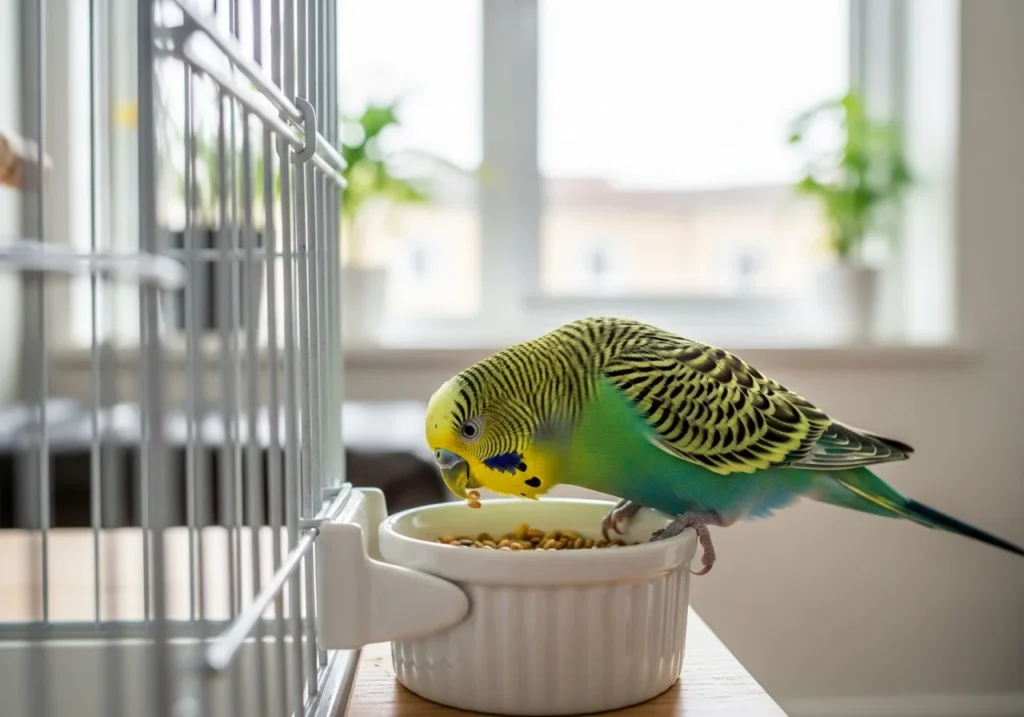
Feeding amounts vary widely by species and size, but as a general rule, a bird's daily food (pellets plus fresh food) should be roughly proportional to its body size — a budgie needs a teaspoon or two daily, while a large macaw needs considerably more.
Feeding amounts vary widely by species and size, but as a general rule, a bird’s daily food (pellets plus fresh food) should be roughly proportional to its body size — a budgie needs a teaspoon or two daily, while a large macaw needs considerably more.
Rough Daily Guide by Size
| Bird Size | Approx. Daily Food |
|---|---|
| Small (budgie, finch) | 1-2 teaspoons pellets + fresh food |
| Medium (cockatiel, conure) | 2-4 tablespoons pellets + fresh food |
| Large (macaw, cockatoo) | 1/2-3/4 cup pellets + fresh food |
Watch the Bird, Not Just the Bowl
Birds often scatter and discard food while eating, making bowls look emptier than actual intake — weigh food before and after, or monitor body condition and weight over time rather than relying purely on visual bowl checks.
Pellets vs. Seed Mix: Why the Base Diet Matters
A seed-only diet is one of the most common mistakes new bird owners make, and it’s a serious one. Seeds are high in fat and low in the vitamins and minerals birds need, and most birds will happily pick out the seeds they like best and leave the rest — meaning a “balanced” seed mix often isn’t balanced by the time your bird is done selecting from it. Pellets are formulated so every bite has the same nutritional makeup, removing that selective-eating problem entirely.
The safest approach for most companion birds is a pellet-based diet making up roughly 60-70% of daily intake, with fresh vegetables and a smaller amount of fruit filling the rest, and seeds treated as an occasional treat rather than a dietary staple.
Fresh Foods: What to Offer Daily
Fresh vegetables should make up a meaningful part of daily intake, not just an occasional extra. Dark leafy greens (kale, spinach in moderation, romaine), bell peppers, carrots, broccoli, and squash are all good regular options. Fruit is fine in smaller amounts — berries, apple (no seeds), melon, and banana are popular choices — but fruit’s higher sugar content means it should be a smaller portion of the plate than vegetables, more treat than staple.
Wash all produce thoroughly and remove uneaten fresh food after a few hours, since it spoils faster than pellets and can grow bacteria quickly, especially in a warm room.
Foods That Are Genuinely Toxic to Birds
- Avocado — contains persin, which is toxic to birds and can cause heart damage or sudden death even in small amounts.
- Chocolate and caffeine — both are toxic to birds’ cardiovascular and nervous systems, same general risk category as in dogs but at even smaller relative doses.
- Onion and garlic — can damage red blood cells with repeated exposure.
- Apple seeds, cherry pits, and similar fruit pits — contain trace cyanide compounds; the fruit flesh is fine, but seeds and pits should always be removed first.
- Salty or sugary human snacks — birds are far more sensitive to sodium than humans; even a few salty chips can cause serious kidney stress in a small bird.
- Xylitol (found in sugar-free gum and some peanut butters) — toxic in small quantities, same as in dogs.
Feeding Schedule and Timing
Most companion birds do well with pellets available throughout the day (they self-regulate well on pellets, unlike on free-fed seed) plus one or two dedicated fresh-food servings, typically morning and early evening. Feeding fresh food around the same time each day also builds a predictable routine, which helps you notice an appetite change quickly — a bird that normally dives for its morning veggies but suddenly ignores them is giving you useful information.
Avoid feeding directly before bedtime with unfamiliar fresh foods, since digestive upset overnight is harder to catch and address quickly.
Signs You’re Overfeeding or Underfeeding
Since bowls can be misleading (birds scatter food while eating), body condition is the more reliable signal. Gently feel along the keel bone (breastbone) — in a bird at healthy weight, you should feel a slight padding of muscle on either side of a bone that’s still easy to locate. A keel bone that feels sharp and prominent with little muscle suggests underfeeding or illness; one that’s hard to feel at all under a thick padding suggests overfeeding.
Weighing your bird weekly on a small kitchen or gram scale is one of the most reliable habits you can build — a consistent downward trend over a couple of weeks is worth a vet call even if nothing else looks obviously wrong.
Feeding Considerations by Life Stage
Young, growing birds and breeding females have meaningfully higher nutritional needs than an average adult pet bird, and both benefit from a calcium source (cuttlebone or mineral block) readily available. Older birds, especially those slowing down physically, may need slightly reduced portions to avoid weight gain, since their activity level typically drops while appetite often stays the same.
If you’re transitioning an older, seed-dependent bird to a pellet-based diet, do it gradually over several weeks rather than switching overnight — birds can be reluctant to try unfamiliar food, and a bird that refuses to eat entirely rather than try pellets is a genuine risk. Mixing increasing ratios of pellets into the existing seed mix over time works better than a hard switch.
Water: The Overlooked Half of Feeding
Fresh water should be changed daily at minimum, more often if it becomes soiled with food or droppings, which happens quickly with some species. Avoid flavored or vitamin-supplemented water additives unless specifically recommended by a vet — most healthy birds on a good pellet-and-fresh-food diet don’t need additional supplementation, and unused supplement residue in a water dish becomes a bacterial growth risk of its own.
Species-Specific Feeding Notes
General guidelines are a starting point, but a few species have notable quirks worth knowing:
- Budgies and cockatiels — prone to becoming picky, seed-fixated eaters if allowed; earlier introduction to pellets and vegetables (ideally as chicks) makes for a much easier adult diet.
- Lories and lorikeets — have unusual nutritional needs built around nectar-feeding in the wild, and require a specialized nectar or lory-specific pellet diet rather than standard parrot pellets, which don’t suit their digestive system.
- African greys — have a documented higher risk of calcium deficiency and related seizures, making a reliable calcium source (cuttlebone, mineral block, or vet-guided supplementation) especially important for this species.
- Macaws and large cockatoos — need more fat in the diet relative to smaller species, so a small amount of nuts (unsalted, unflavored) is appropriate as treats in a way that would be too rich for a budgie-sized bird.
How Much a Bird’s Diet Actually Costs
Budgeting for bird nutrition is modest for small species and climbs for larger ones. A budgie or cockatiel typically costs $10-$20 a month in quality pellets plus fresh produce shared from household groceries. Conure-sized birds run closer to $20-$35 a month. Large parrots — macaws, cockatoos, large African greys — can run $40-$70 a month or more, especially if fed a premium pellet brand plus a wide fresh-food rotation. These are ongoing costs worth factoring in before bringing home a larger species, since the difference between a small and large parrot’s food bill compounds significantly over a bird’s multi-decade lifespan.
Common Feeding Mistakes New Owners Make
- Assuming “the bowl looks full” means the bird is eating enough — scattered seed husks and discarded pellets can make an empty bowl look full at a glance.
- Offering too much fruit — it’s the bird’s favorite, so owners over-serve it, unintentionally displacing more nutritionally important vegetables and pellets.
- Switching foods abruptly — sudden diet changes can cause a bird to stop eating altogether rather than adapt, especially in stubborn seed-imprinted adults.
- Not accounting for treats given during training — training treats add up calorically and should be factored into the day’s total intake, not treated as separate from the “real” diet.
When to Involve a Vet in Feeding Decisions
Most healthy birds do fine on a solid pellet-plus-fresh-food routine without special guidance. But a few situations are worth a vet consultation specifically about diet: a bird recovering from illness or surgery, a breeding female with increased calcium needs, a senior bird with changing activity levels, or any bird that has been seed-only for a long time and needs a supervised transition plan. An avian vet can also run bloodwork to catch nutritional deficiencies (like calcium or vitamin A) before they become visible health problems.
A Simple Weekly Feeding Checklist
Keeping feeding on track doesn’t need to be complicated. A quick weekly review works well: confirm pellets still make up the bulk of the diet, rotate in at least 3-4 different vegetables across the week rather than repeating the same one daily, check that the water dish is being changed properly, and do a quick keel-bone feel to catch any weight trend early. This small weekly habit catches most feeding issues long before they become a health problem worth a vet visit.
If you’re ever unsure whether a specific human food is safe to share, the safer default is to skip it and stick with known bird-safe vegetables and fruits — the list of genuinely toxic foods is short, but the consequences of guessing wrong can be severe, and there’s rarely a compelling reason to experiment when plenty of confirmed-safe options already exist.
More Birds Guides
FAQ
A vet-taught technique called 'keel bone check' — feeling along the breastbone — helps assess body condition, since feathers make visual weight assessment unreliable. An avian vet can show you this during a checkup.
Most owners offer fresh food once or twice daily, with pellets available for grazing throughout the day, adjusted to the specific species' natural feeding pattern.
If eating a properly balanced pellet-based diet, additional supplements usually aren't necessary — check with an avian vet before adding any supplement, since over-supplementation can also cause harm.
