
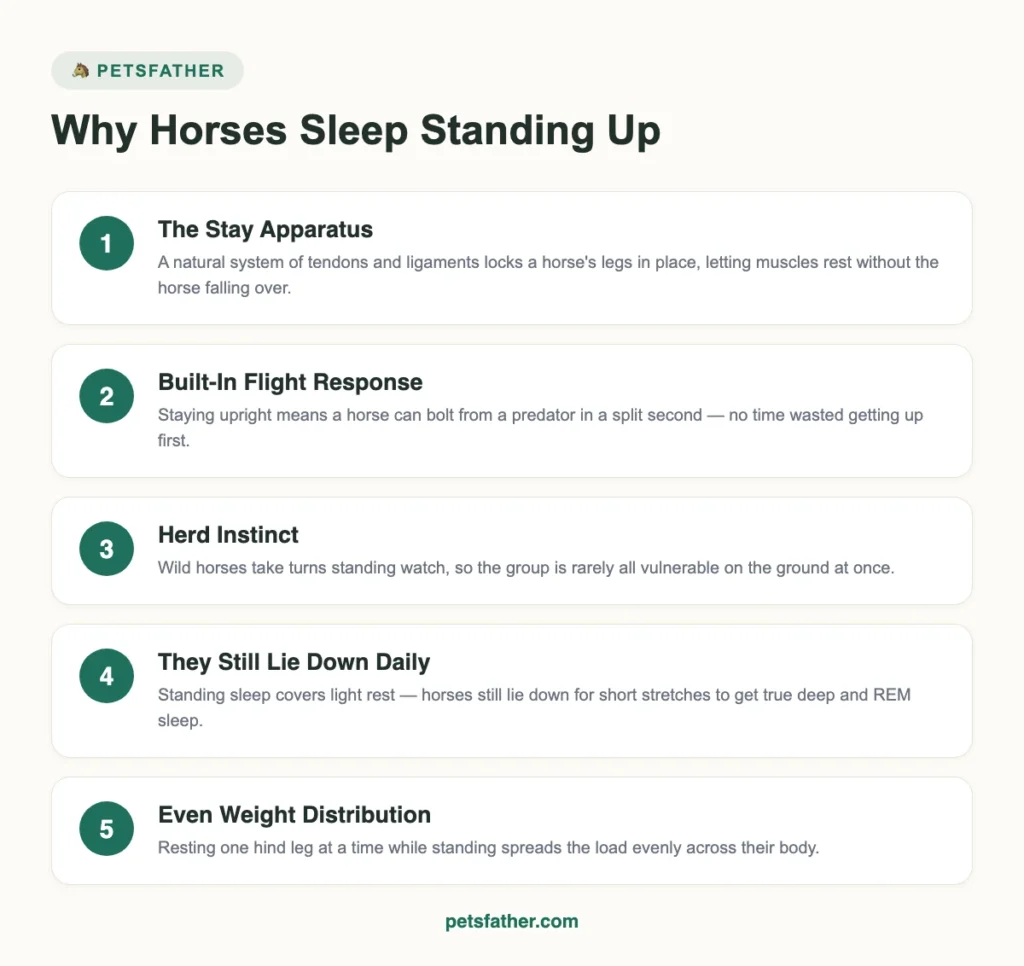
Horses sleep standing up because a natural locking mechanism in their legs, called the stay apparatus, lets their muscles rest without their joints buckling. It’s an instinct built for survival — staying upright means they can react to danger in an instant, even while dozing.
If you’ve ever walked past a horse in a field, head low, eyes half shut, back leg cocked and resting, you’ve probably wondered how it doesn’t just topple over. It’s one of the most asked questions about horses, right up there with why they need shoes. The answer is part anatomy, part evolution, and it explains a lot about how horses actually experience rest.
It’s also a good example of how much horse behavior still traces back to their wild ancestry, even after thousands of years of domestication. A lot of what looks like an odd quirk from the outside turns out to be a genuinely well-engineered survival trait once you understand what it’s actually doing.
The Stay Apparatus: A Built-In Kickstand
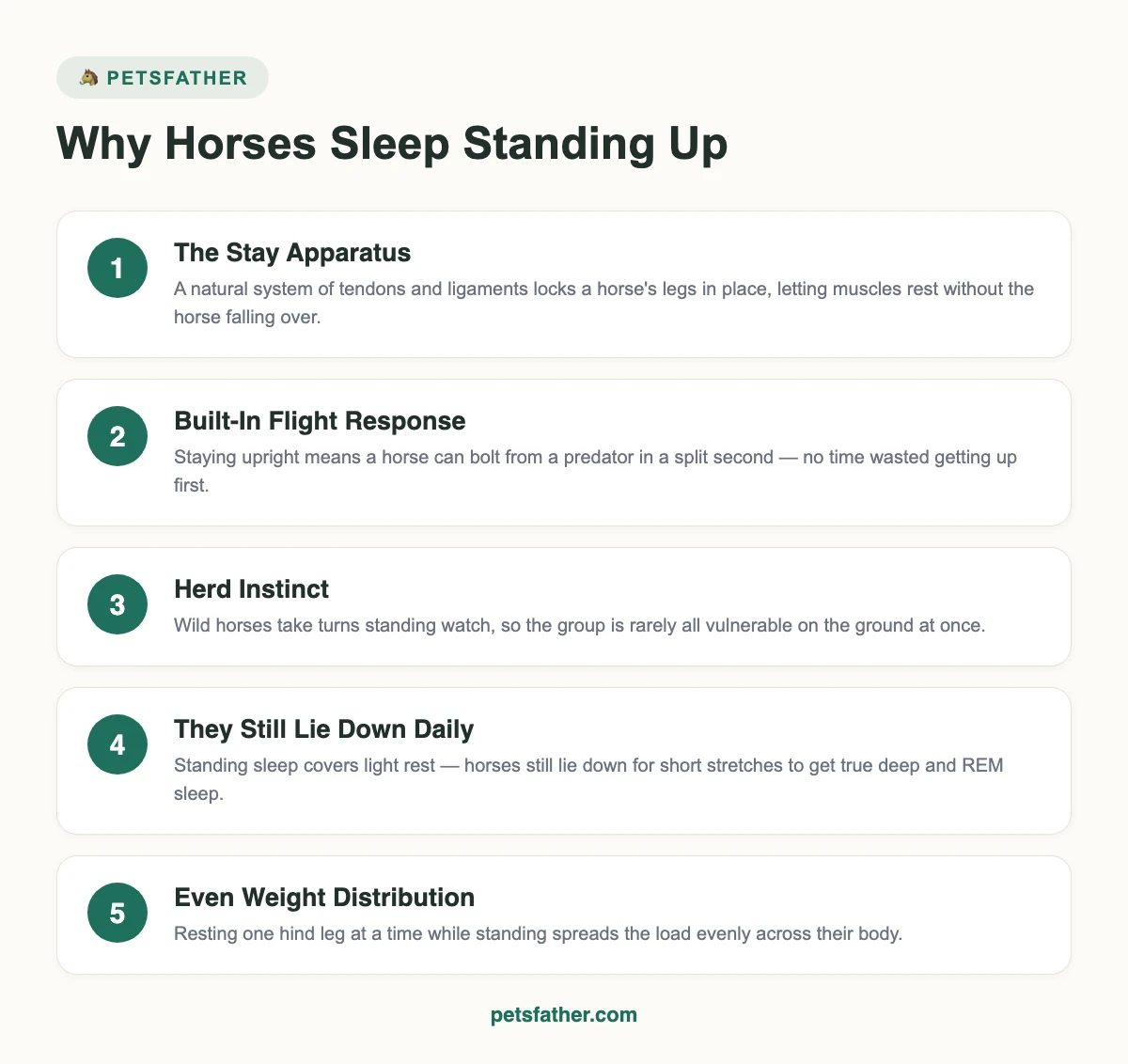
Horses have a system of tendons and ligaments in their legs that locks their major joints in place without any muscular effort. Vets call it the stay apparatus. Once it’s engaged, a horse’s leg becomes rigid enough to bear the animal’s full weight, and the surrounding muscles can genuinely relax. It’s the reason a 1,000-pound animal can doze for long stretches without its legs giving out.
This mechanism is present in all four legs, but horses typically lock the front legs and rest one hind leg at a time, shifting occasionally to even out the load. That’s the source of the classic resting stance — hip dropped slightly on one side, back hoof tipped onto its toe.
It’s a Survival Instinct, Not Just Comfort
Horses are prey animals, and that history still shapes their behavior today, even in a safe, predator-free paddock. Staying on their feet means a horse can go from dozing to a full gallop in seconds, without wasting time scrambling upright first. Lying flat on the ground, by contrast, leaves a horse slow to react and genuinely vulnerable.
Wild and feral horse herds also tend to rest in shifts — while some members doze standing, at least one usually stays more alert, watching for danger. Domestic horses often keep a version of this instinct even when there’s nothing around to watch for.
Do Horses Ever Actually Lie Down?
Yes, and they need to. Standing rest covers light sleep, but horses still require periods of deep sleep and REM sleep, and that only happens lying down. A healthy horse will usually lie down for anywhere from 30 minutes to a couple of hours a day, often in short bursts rather than one long stretch, and usually when they feel safe and relaxed enough to do it.
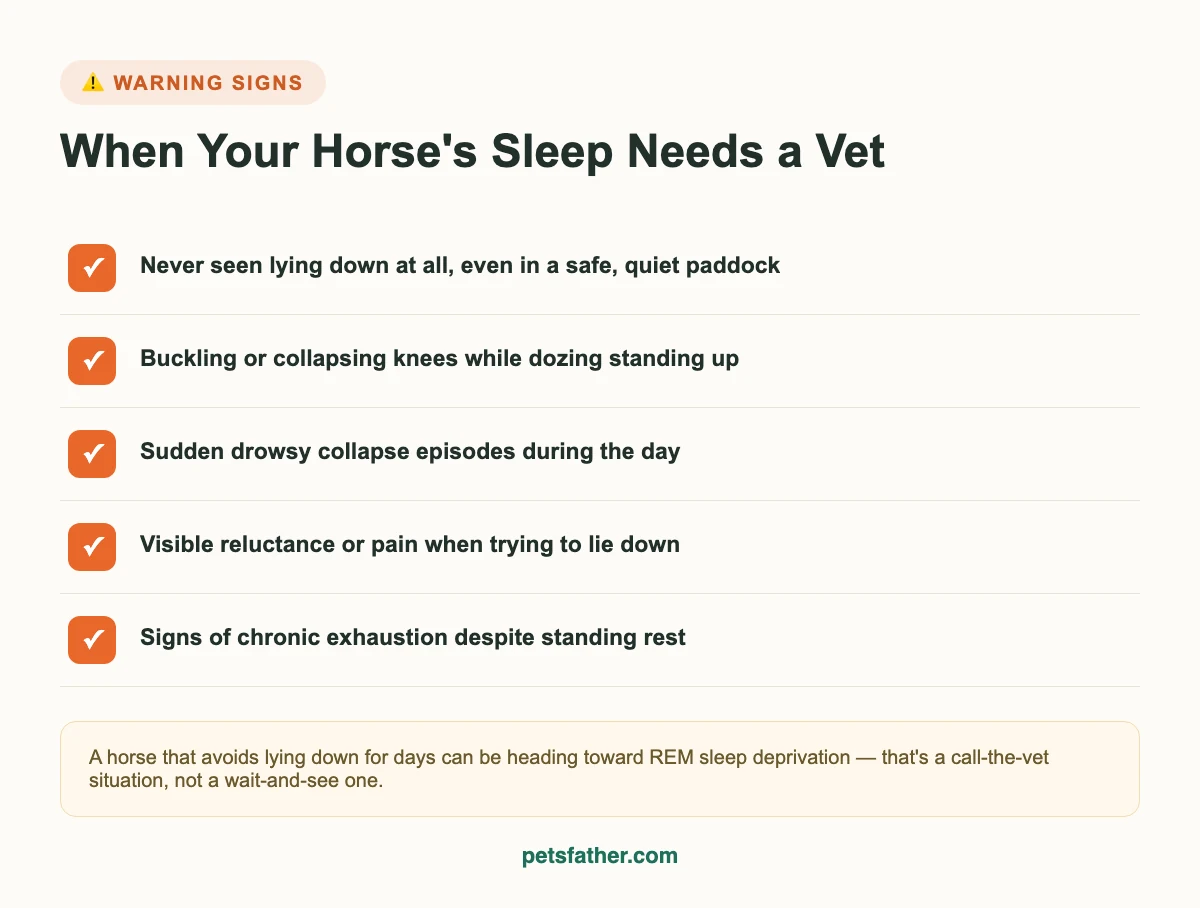
This is worth knowing because a horse that refuses to lie down at all, day after day, isn’t just being quirky — it can be a sign they don’t feel safe, are in pain, or have a herd or environment issue keeping them from settling. REM sleep deprivation in horses is a real, documented problem, and it often shows up as buckling knees or sudden collapse episodes while dozing standing up.
When to Actually Worry About a Horse’s Sleep
Most standing-sleep behavior is completely normal. A few patterns are worth paying closer attention to:
- Your horse is never seen lying down, even in a calm, secure space
- You notice buckling or near-collapse while they’re dozing on their feet
- They seem reluctant or in pain when attempting to lie down
- There are signs of general exhaustion despite plenty of standing rest
- A new herd dynamic or environment change has coincided with a sudden shift in sleep behavior
A single instance of any of these usually isn’t an emergency, but a repeating pattern is worth a call to your vet. Horses are good at hiding discomfort, and sleep changes are often one of the first visible clues something else is going on.
It’s also worth mentioning that not every buckling knee is dramatic. Sometimes it’s subtle enough that an owner only notices it in hindsight, after realizing their horse seems more tired than usual during the day. Keeping a rough mental note of a horse’s normal resting habits makes it much easier to spot when something’s actually changed.
Helping a Horse Feel Safe Enough to Lie Down
If you suspect your horse isn’t getting enough deep sleep, a few things genuinely help:
- Check the footing. Horses are less likely to lie down on hard, wet, or uneven ground — deep, dry bedding in a stall or a soft, sheltered spot in a paddock makes a real difference.
- Look at herd dynamics. A horse being bullied or kept on edge by a dominant herd mate may avoid lying down out of caution. Separating or rearranging groups sometimes solves this on its own.
- Reduce noise and disruption. A quieter, more predictable environment during rest hours can make a nervous horse more willing to settle.
- Rule out pain. Joint pain, especially in older horses, can make lying down and getting back up genuinely difficult — a vet or farrier visit can rule this in or out.
- Give them enough space. A horse needs room to fully stretch out and roll back up again — cramped stalls can discourage lying down even when everything else is fine.
- Watch group size in turnout. Very large or unstable herd groupings can leave a horse feeling like there’s never a safe moment to lie down. Smaller, more settled groups tend to rest better.
If a horse’s sleep pattern changes suddenly and none of the obvious explanations fit, that’s the point to get a vet involved rather than waiting to see if it resolves on its own.
How Foals Sleep Differently Than Adult Horses
Foals are the exception to a lot of this. Their stay apparatus isn’t fully developed at birth, so young foals actually spend much more time lying flat than standing, and they need considerably more total sleep than adults do. It’s common to see a foal sprawled out and seemingly dead to the world in a pasture, which can genuinely alarm first-time horse owners who aren’t expecting it.
As a foal’s legs and tendons mature over the following months, standing rest gradually becomes the dominant pattern, matching what you’d see in an adult horse. By the time a horse reaches maturity, the balance has fully shifted toward standing sleep punctuated by shorter periods lying down.
This is also part of why foals are usually kept somewhere extra secure — lying flat for long stretches leaves them more vulnerable than an adult, so a safe, predator-free environment matters even more in those early months.
How This Compares to Other Grazing Animals
Horses aren’t unique in resting on their feet, but they’re unusually good at it. Cattle have a related tendon-locking system, though they tend to lie down more of the time overall than horses do. Elephants, another large prey-adjacent species, also sleep standing for much of the night and lie down only briefly. The common thread across all of these animals is size and vulnerability — bigger, slower-to-rise animals benefit the most from a body built to rest without ever fully powering down.
More Horses Guides
FAQ
Not for long. Standing rest covers light sleep, but horses need to lie down regularly to get deep and REM sleep. Going too long without lying down can lead to real sleep deprivation.
Horses typically sleep around 3 to 5 hours total in a 24-hour period, spread across many short naps rather than one long stretch — most of it standing, with shorter periods lying down.
Yes, this is completely normal. Horses often doze standing in their stall between periods of lying down, especially during the day.
The stay apparatus, a system of tendons and ligaments, locks the leg joints in place so the muscles can rest without the horse needing to actively balance or hold itself up.
Foals actually lie down far more than adult horses and need more total sleep. Their stay apparatus isn't fully developed yet, so extended standing sleep becomes more prominent as they mature.
A sudden change like this is worth investigating — possible causes include pain, herd stress, an unsafe or uncomfortable environment, or an underlying health issue. It's a good reason to call your vet if it continues for more than a few days.
Some other large grazing animals, like cattle, have similar adaptations, though the details of the stay apparatus are especially well developed in horses specifically.
