
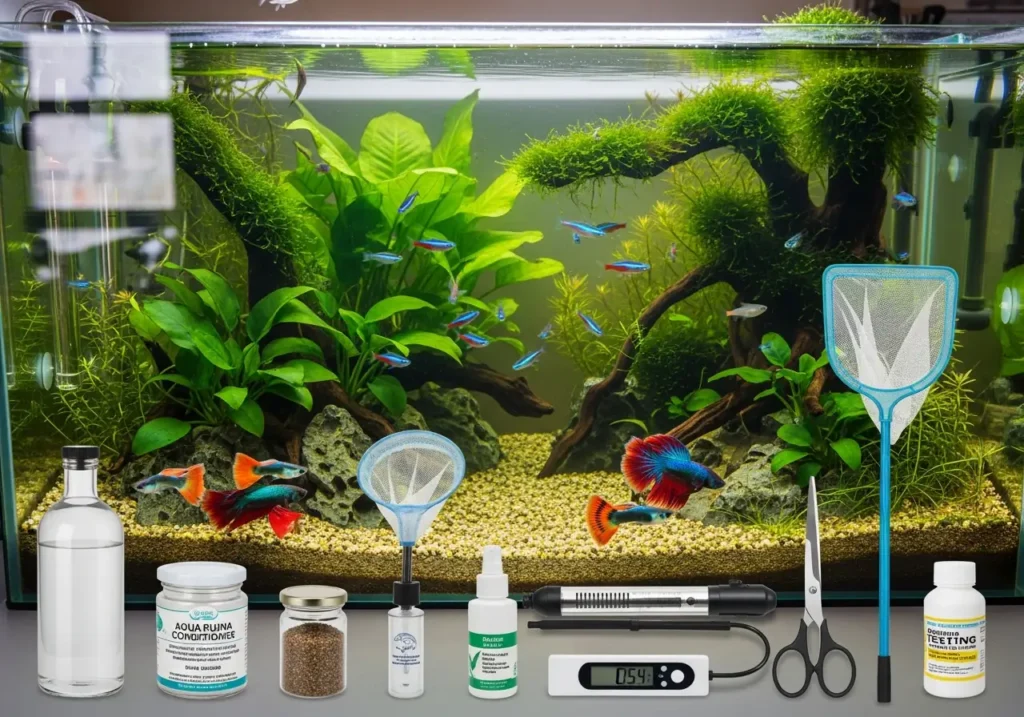
You don’t need every accessory on the pet store shelf, but a handful of items genuinely make the difference between a stable tank and a constant battle.
Filter
Non-negotiable for almost any tank. Hang-on-back (HOB) filters are the easiest starting point for beginners; canister filters suit larger tanks; sponge filters are gentle and great for fry or shrimp tanks. See our filter buying guide for a full comparison.
Tank
Bigger tanks are more forgiving of beginner mistakes because water parameters shift more slowly in a larger volume. See our fish tank buying guide for size and material recommendations.
Heater
Required for tropical fish, skip it for true coldwater species. Look for one with a built-in thermostat rather than a fixed-temperature model.
Test Kit
A liquid-reagent test kit for ammonia, nitrite, nitrate, and pH is one of the best investments you can make — far more accurate than test strips over the long run.
Other Useful Gear
A gravel vacuum makes water changes dramatically easier, a net avoids stressing fish during transfers, and a simple LED light supports live plants if you choose to add them.
Replacing Worn or Outdated Supplies on Schedule
Some supplies degrade or lose effectiveness gradually rather than failing obviously — water conditioner and test kit reagents lose potency past their expiration date, and even sturdy items like nets or gravel vacuums eventually wear out. Periodically reviewing your supply cabinet for anything past its useful life, rather than only replacing items after an obvious failure, keeps your maintenance routine reliably effective.
Water Conditioner and Dechlorinator
Tap water contains chlorine or chloramine that’s toxic to fish and beneficial bacteria — a dechlorinating water conditioner, added at every water change, is a non-negotiable basic supply rather than an optional extra. Some conditioners also detoxify heavy metals and add a protective slime coat, worth checking for on the label if your tap water quality is a concern.
Gravel Vacuum and Basic Cleaning Tools
A gravel vacuum (siphon) makes routine water changes dramatically easier by removing debris from the substrate at the same time you remove water, rather than requiring separate cleaning steps. An algae scraper or pad and a soft aquarium-safe brush round out the basic cleaning toolkit most tanks need on a regular maintenance schedule.
Decor and Hiding Spots as Functional, Not Just Aesthetic
Decor isn’t purely decorative — hiding spots reduce stress for more skittish species and give territorial fish places to establish their own space, reducing aggression in mixed community tanks. Choose aquarium-safe materials specifically (some decorative items sold for terrariums or general home decor aren’t rated safe for submerged, fish-occupied use).
The Bottom Line
Prioritize a quality test kit and dechlorinator as genuinely essential rather than optional supplies, add a gravel vacuum to simplify your maintenance routine, and choose decor with both your fish’s behavioral needs and aquarium safety in mind, not appearance alone.
Aquascaping Supplies Worth Knowing About
Beyond basic decor, aquascaping tools like curved planting tweezers (for precise placement in dense layouts), a small trimming scissor set for live plants, and root tabs or substrate fertilizer for rooted plant species all support a more deliberately designed tank. These aren’t necessary for a basic beginner setup but become genuinely useful as planted-tank ambitions grow.
Choosing Aquarium-Safe Decor
Not everything sold as “decor” is safe for submerged, fish-occupied tanks — some items intended for terrariums or general home decor contain metals, paints, or treatments that can leach harmful substances into water over time. Stick to items explicitly labeled aquarium-safe, and when in doubt, avoid untested decor, however attractive, rather than risk a slow-building toxicity issue that’s hard to trace back to its source.
Cleaning Tools and Maintenance Supplies
Beyond a gravel vacuum, a dedicated algae scraper (magnetic cleaners are convenient for glass tanks, avoiding the need to reach into the water for routine glass cleaning), a bucket reserved only for aquarium use (never one that’s held soap or chemicals), and a turkey baster or similar tool for spot-cleaning debris from tight decor gaps round out a practical maintenance toolkit.
Organizing Supplies for Consistent Maintenance
Keeping test kits, conditioner, and cleaning tools together in one easily accessible location (rather than scattered) removes friction from the weekly maintenance routine — the easier it is to grab what you need, the more likely a consistent schedule actually happens, which matters more for long-term tank health than any single premium product.
Substrate as a Functional Supply Choice
Substrate choice affects more than appearance — fine sand suits species that like to dig or sift, while larger gravel provides better anchoring for some plant root systems. Species-appropriate substrate choice is worth researching specifically for bottom-dwelling fish, which interact with it far more directly than free-swimming mid-water species.
Building Your Supply List Incrementally
Rather than buying every possible supply on day one, prioritize the genuinely essential items (test kit, conditioner, basic cleaning tools) first, then add aquascaping or convenience items as your specific tank’s needs and your own interests become clearer over the first few months of keeping it.
Reassessing Supply Needs as Your Tank Evolves
A tank’s supply needs change as it matures — a heavily planted tank that develops over its first year may need trimming tools and fertilizer it didn’t need at setup, while a tank that shifts toward more specialized fish may need supplies tailored to their specific requirements. Revisit your supply kit periodically rather than assuming your initial purchases cover every future need.
Balancing Function and Budget Across Your Supply List
Prioritize spending on supplies with direct fish-health impact (test kits, filtration-related items, conditioner) over purely aesthetic purchases when working with a limited budget — a beautifully decorated tank with poor water quality management is a worse outcome for your fish than a simply decorated tank with excellent water quality fundamentals in place.
Supply Needs for Specific Tank Goals
A breeding-focused setup needs supplies (separate rearing tanks, specialized fry food, sponge filters gentle enough for fry) that a simple community display tank doesn’t require, while a heavily aquascaped tank needs plant-care tools a fish-only tank can skip entirely — tailor your ongoing supply investment to your tank’s actual specific goals.
How Supply Choices Reflect Your Specific Tank’s Maturity Stage
A brand-new tank’s supply priorities — cycling aids, a reliable test kit, basic cleaning tools — differ meaningfully from an established tank’s priorities, which might shift toward specialized foods, aquascaping tools, or breeding-support supplies depending on how your interests have developed. Regularly reassessing what your tank actually needs at its current stage, rather than accumulating supplies indefinitely based on initial assumptions, keeps your investment aligned with what will genuinely benefit your fish and your specific goals going forward.
Learning Which Supplies Were Worth the Investment
After some months of experience, most keepers can identify which of their initial supply purchases turned out genuinely valuable versus which were less necessary than expected — sharing or reflecting on this kind of practical, experience-based assessment (through keeper communities or your own notes) helps refine future purchasing decisions and often reveals that a smaller, more thoughtfully chosen supply list serves a tank just as well as a larger, less considered one.
Distinguishing Genuinely Essential From Merely Convenient Supplies
When budget is limited, clearly separating supplies that directly affect fish health and safety (test kits, conditioner, appropriately sized filtration) from those that primarily add convenience or aesthetics (specialized aquascaping tools, decorative extras) helps you prioritize spending wisely without compromising on what actually matters most for your fish’s wellbeing.
Learning Supply Needs Through Direct Experience
Some supply needs only become apparent once you’re actually running a tank day to day — a specific tool that makes a recurring task easier, or a supply you didn’t anticipate needing until a particular situation arose. Staying open to adding supplies as genuine needs emerge, rather than trying to anticipate everything perfectly in advance, is a normal and sensible part of the ongoing learning process.
Reassessing Supplies When Changing Tank Direction
If your goals shift significantly — moving from a simple community tank toward breeding, showing, or a heavily aquascaped display — expect a corresponding shift in which supplies matter most, and don’t hesitate to retire supplies that no longer serve your current direction in favor of ones that better support where your tank and interests are actually heading.
Supplies as Tools in Service of Fish Welfare, Not Ends in Themselves
It’s worth periodically stepping back and remembering that every supply purchase should ultimately serve your fish’s actual wellbeing, whether directly (water quality, nutrition) or indirectly (reducing your own stress and effort so you maintain the tank more consistently) — keeping this framing in mind helps prioritize genuinely useful purchases over accumulating gear for its own sake.
A thoughtfully chosen, genuinely useful supply kit — built gradually and matched to your tank’s real needs — serves your fish and your own maintenance routine far better than an impulsive, oversized purchase made all at once before you’ve learned what actually matters most for your specific setup.
A well-stocked, well-maintained supply kit is a small, one-time investment that pays for itself many times over in fish health and keeper peace of mind.
More Fish & Aquarium Resources
