
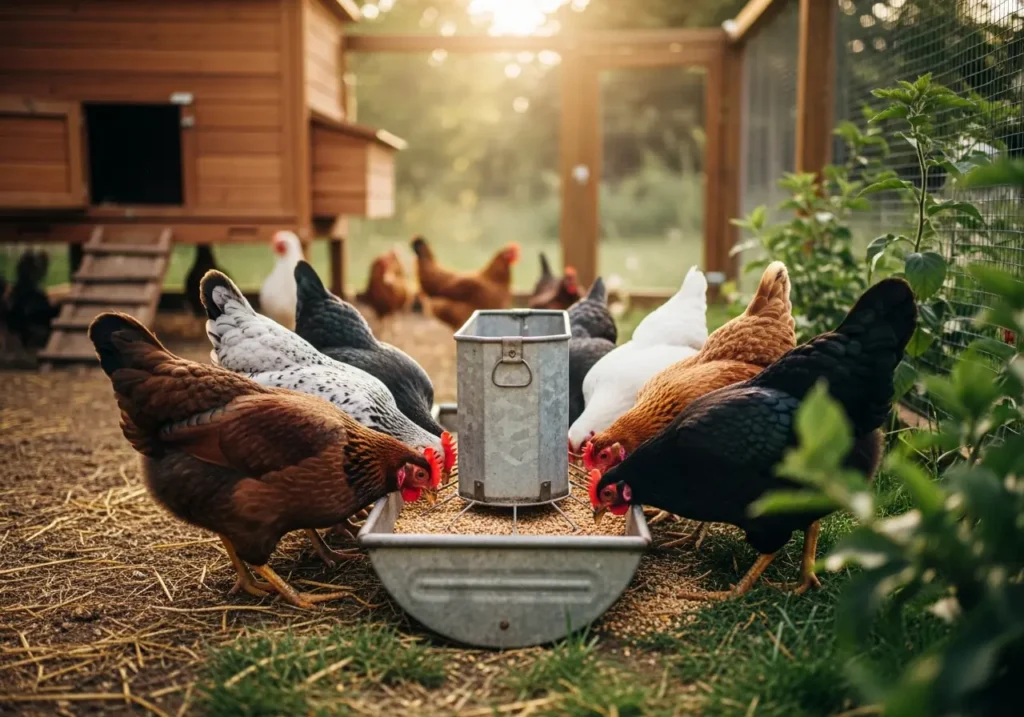
Most adult laying hens eat roughly a quarter-pound of layer feed per day, though this varies with breed size, season, and how much they forage — free access to feed during the day is the simplest way to let birds self-regulate.
Free-Choice Feeding Works Well
Unlike some pets prone to overeating, backyard chickens generally self-regulate well when feed is available throughout the day, similar to their natural foraging pattern. A large-capacity feeder that’s refilled as needed is simpler than trying to portion exact daily amounts.
Seasonal Variation
Chickens often eat more in cold weather since they burn extra energy maintaining body temperature, and may eat somewhat less in very hot weather when appetite naturally drops. Adjust feed supply accordingly rather than sticking to a fixed year-round amount.
Foraging Reduces Feed Needs
Flocks with regular access to free-ranging or a large, bug- and plant-rich run will naturally eat less commercial feed, supplementing their diet with foraged food. Confined flocks rely more fully on the feed provided.
Watching for Over- or Under-Feeding
Consistently overweight birds (harder to assess visually under feathers, but noticeable in overall body shape and reduced activity) may be getting too many high-calorie treats. Thin, listless birds with reduced feed consumption may be sick rather than simply eating less — a drop in appetite is worth investigating.
See our Best Food for Backyard & Farm Pets guide for feed-type recommendations by life stage.
General Daily Feeding Guidelines
A standard-size adult laying hen typically eats roughly 1/4 to 1/3 pound of feed daily, though this varies by breed size, activity level, temperature, and whether birds have significant additional foraging access. Free-choice feeding (feed available essentially all day) is the standard, straightforward approach for most backyard flocks, allowing birds to self-regulate intake rather than requiring precise portioning the way some other animals do.
Adjusting for Free-Range Access
Flocks with substantial free-range or large run access supplement their diet significantly through foraged bugs, plants, and grit, meaning they may eat somewhat less commercial feed than fully confined birds. This isn’t a reason to reduce feed availability deliberately — let birds self-regulate with free-choice access regardless of foraging opportunity, since foraging supplements rather than replaces a nutritionally complete commercial feed.
Seasonal Appetite and Consumption Changes
Feed consumption typically rises in cold weather as birds burn more calories maintaining body temperature, and may dip somewhat in extreme heat when appetite naturally decreases. Monitoring actual feed consumption patterns across seasons, rather than assuming a fixed daily amount year-round, helps ensure your flock’s changing caloric needs are actually being met.
Signs Your Feeding Approach Needs Adjustment
Consistently empty feeders well before the next refill (suggesting insufficient feed availability), significant feed waste or spoilage (suggesting overfeeding relative to consumption), or visible weight or condition changes in individual birds are all worth investigating rather than assuming your initial feeding setup remains correct indefinitely as flock size, season, or individual bird needs change.
Feeding Chicks and Growing Birds
Young chicks eat proportionally more relative to body size than adults, supporting rapid early growth, and should have consistent access to appropriate starter feed rather than adult-style scheduled feeding. As birds mature into the grower and eventually laying stage, feed formulation matters more than precise quantity adjustment — free-choice access to the correctly formulated feed for their current life stage remains the standard, straightforward approach throughout development.
Multiple Feeding Stations for Larger Flocks
Larger flocks benefit from multiple feeding stations positioned around the run rather than a single feeder, reducing competition and ensuring lower-ranking birds in the pecking order get adequate access rather than being pushed away from a single contested feeding point by more dominant flock members.
How Breed Size Changes Daily Feed Amounts
Bantam breeds eat noticeably less than standard-size breeds — often closer to 1/8 to 1/6 pound daily rather than the 1/4 to 1/3 pound typical of a standard laying hen — while larger dual-purpose or heavy breeds can eat somewhat more than the average. Mixed-breed flocks don’t need separate feeding regimens for this reason alone, since free-choice feeding lets each bird naturally eat to its own size and activity level, but it’s worth understanding this variation so you’re not troubleshooting a “problem” that’s simply normal breed-size variation when a bantam in the flock consistently eats less than a larger flockmate.
The Treat Portion Rule Most Keepers Underestimate
Treats and scratch grain should stay under roughly 10% of a flock’s total daily intake to avoid displacing the nutritionally complete feed that provides balanced protein and calcium. It’s easy to underestimate how quickly treat-feeding adds up, especially with multiple household members offering scraps throughout the day without coordinating — a flock that seems to be eating a reasonable amount of feed can still end up nutritionally short if treats are quietly making up a much larger share of total intake than intended. Keeping treats to specific times (like a supervised evening handful) rather than constant ad-hoc offering makes this easier to track.
Why Feed Consumption and Egg Production Are Linked
A hen actively laying at a normal rate needs meaningfully more calories and calcium than the same hen not laying, so consumption naturally rises during peak laying periods and drops during a molt or the natural winter slowdown many breeds experience with shortening daylight. A sudden, unexplained drop in feed consumption without a corresponding seasonal or molt-related reason is worth treating as a possible early illness sign rather than assumed normal variation, since appetite loss is often one of the first visible symptoms in an otherwise outwardly normal-looking bird.
Water Intake and Its Relationship to Feed Consumption
Chickens drink roughly twice as much water by weight as the feed they eat, and inadequate water availability directly suppresses feed intake, since dry feed is genuinely difficult to process without adequate water alongside it. A flock that seems to be under-eating relative to expectations is worth checking for a water access problem — a fouled, frozen, or simply insufficient water source — before assuming the issue is with the feed itself or the birds’ health.
Reducing Feed Waste Through Feeder Design
Open trough feeders lose a meaningful amount of feed to scratching, spillage, and contamination compared to treadle or hanging feeders designed to minimize waste, and reducing this waste effectively increases how far a given amount of feed goes without changing what or how much birds actually consume. For keepers trying to understand why feed seems to disappear faster than expected calculations suggest, feeder design and placement (height adjusted to bird size, positioned away from areas prone to spillage into bedding) is often a bigger factor than the birds simply eating more than average.
Feeding Amounts for a Mixed-Age Flock
A flock spanning multiple life stages at once — chicks, growing pullets, and mature layers together — complicates simple per-bird feed estimates, since each group’s needs differ in both quantity and formulation. Many keepers manage this by offering an all-flock or grower-type feed with free-choice calcium available separately, letting laying hens self-supplement while younger, non-laying birds aren’t over-exposed to calcium levels meant for actively laying adults. Estimating total flock feed needs in this situation is more reliably done by tracking actual consumption over a week or two than by trying to calculate precise theoretical amounts for each age group separately.
When to Stop Worrying About Exact Amounts
For most backyard keepers with a small-to-moderate flock, free-choice feeding with periodic observation is genuinely sufficient — obsessively weighing feed daily is rarely necessary once you’ve confirmed your flock’s general consumption pattern is stable and their body condition, activity, and egg output all look normal. Precise quantity tracking becomes more useful specifically when troubleshooting a suspected problem (unexplained weight change, a production drop, cost concerns) rather than as an ongoing daily practice for a healthy, stable flock.
Feeding Amounts During Illness or Recovery
A sick or recovering bird often needs a different short-term feeding approach than the general flock — easier-to-digest options, closer monitoring of whether it’s actually eating (sometimes requiring separation from more dominant flockmates who might otherwise crowd out a weakened bird), and patience with reduced intake during acute illness followed by close attention as appetite returns during recovery. Don’t assume a sick bird will simply self-regulate normally within a mixed-flock free-choice setup the way healthy birds do — active monitoring matters more during this period.
Tracking Feed Cost Against Consumption
Once you have a stable sense of your flock’s actual weekly feed consumption, it becomes straightforward to estimate ongoing feed costs and spot when something has changed — a sudden increase might mean more waste, more birds, or higher-need conditions like a molt or cold snap, while a sudden decrease is more often a red flag worth investigating than a welcome cost saving. This simple ongoing awareness, more than any precise daily measurement, is what most experienced keepers actually rely on to catch feeding-related problems early.
A Quick Reference for New Keepers
If you’re starting out and unsure where to begin, a reasonable default is: free-choice feed available all day, a rough expectation of about a quarter-pound per standard adult bird daily, weekly observation of consumption trends, and treats kept to a small supervised portion rather than constant availability. Adjust from there based on your specific flock’s breed mix, season, and foraging access rather than treating any single number as a fixed rule.
More Backyard & Farm Pets Guides
FAQ
For most backyard flocks, yes — free-choice access lets hens regulate their own intake naturally, similar to how they'd forage throughout the day in the wild.
Often yes — birds burn more energy staying warm in cold weather, so feed consumption commonly rises during winter months.
Yes, especially with too many high-calorie treats alongside free-choice feed — treats should stay a minor part of the total diet.
