
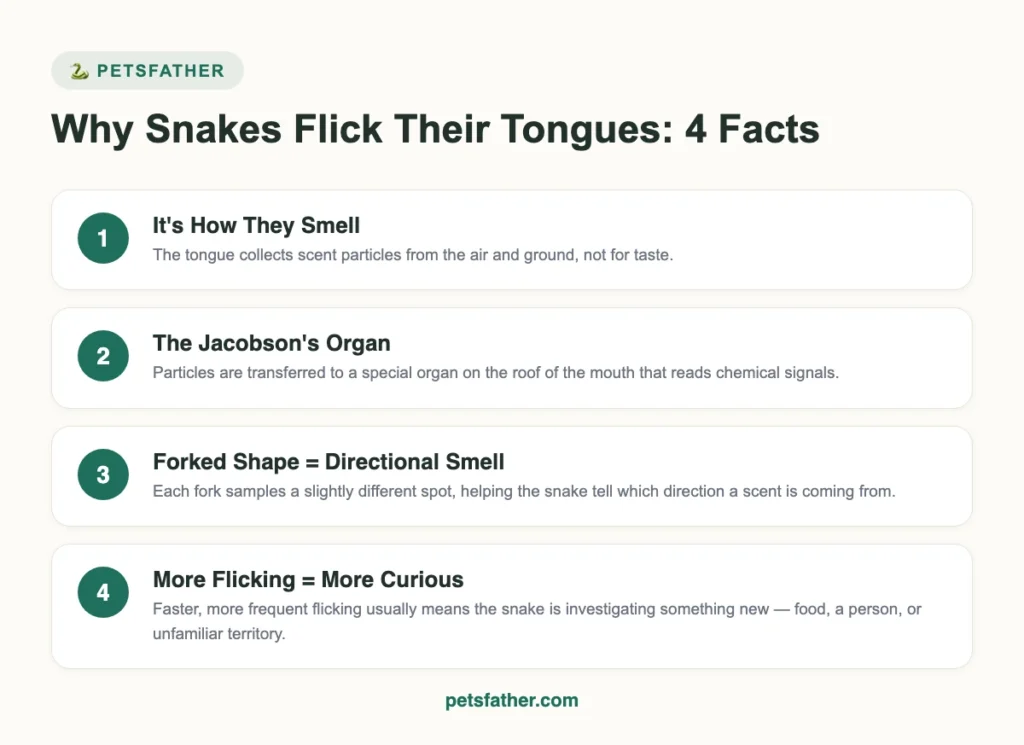
Snakes flick their tongues to smell and taste the air around them, not to threaten or communicate aggression. The forked tip picks up scent particles and delivers them to a special sensory organ in the roof of the mouth, giving the snake a detailed picture of its surroundings.
If you’ve ever watched a pet snake and noticed that quick, flickering tongue motion, it can look a little unsettling if you don’t know what it means. It’s actually one of the most normal, constant behaviors a healthy snake displays — closer to how a dog sniffs the ground than anything threatening.
Tongue-Flicking Is How Snakes “Smell”
Snakes don’t rely on their nose the way most mammals do. Instead, their forked tongue collects scent particles and tiny chemical traces from the air, ground, water, or any surface it touches. Each flick is essentially a snake taking a very detailed sniff of its environment.
That’s why you’ll see more flicking when a snake is exploring a new enclosure, investigating a new object, or checking out anything unfamiliar. It’s gathering information, not preparing to strike.
The Jacobson’s Organ: The Real Star of the Show
Once the tongue retracts, it delivers the collected particles to a pair of small pits on the roof of the mouth called the Jacobson’s organ (also known as the vomeronasal organ). This organ translates the chemical information into signals the snake’s brain can interpret — essentially converting the sniff into usable data about what’s nearby.
This system is so effective that a snake’s tongue-and-Jacobson’s-organ combo can outperform a human nose by a wide margin, letting the snake track prey, detect predators, and find mates almost entirely through scent.
Why the Fork Shape Matters
The forked tip isn’t just for show. Each side of the fork samples a slightly different location, and by comparing the concentration of scent particles picked up on the left versus the right, the snake can figure out which direction a scent is coming from. It’s a built-in directional tracking system, similar in concept to how some animals use two ears to locate sound.
Does Flicking Speed or Frequency Mean Anything?
Yes, to an extent. A snake flicking slowly and occasionally is usually just doing routine environmental scanning. Rapid, frequent flicking tends to show up when a snake is more actively investigating — near feeding time, when a new object or person is introduced, or when exploring unfamiliar territory after a habitat change.
None of this is a warning sign on its own. Tongue-flicking is not related to aggression, and a flicking tongue does not mean a snake is about to bite. Snakes give much clearer warning signs before striking, like coiling, hissing, or pulling into an S-shaped posture.
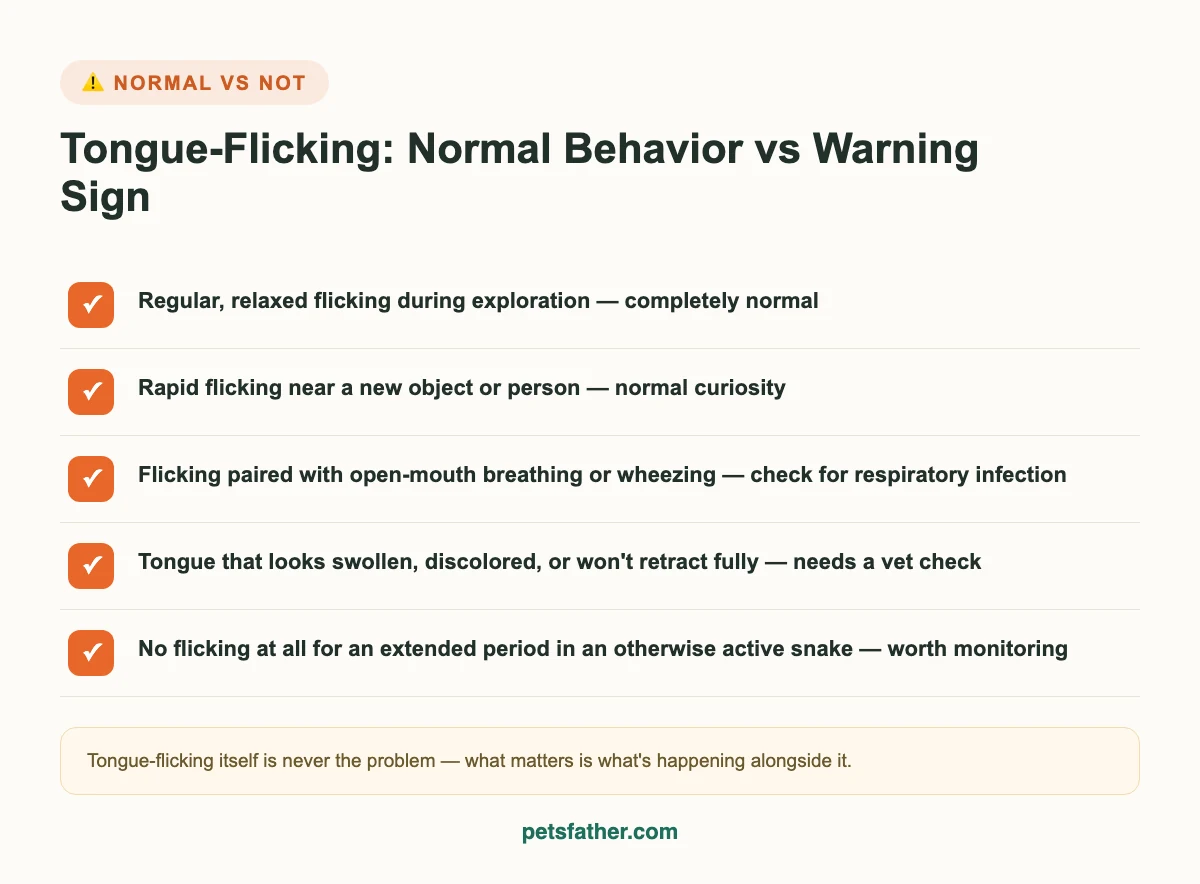
When Tongue Behavior Might Signal a Problem
Tongue-flicking itself is essentially never the issue. What matters is what’s happening around it. A few things worth paying attention to:
- Flicking paired with open-mouth breathing or audible wheezing can point to a respiratory infection, which needs a reptile vet.
- A tongue that looks swollen, discolored, or doesn’t fully retract is not normal and should be checked out.
- A sudden, extended stop in tongue-flicking in an otherwise active, healthy snake is worth monitoring, especially if paired with lethargy or appetite loss.
- Visible tongue injury — bruising, bleeding, or an oddly bent fork — can sometimes happen from an enclosure mishap and should be looked at.
Outside of those specific situations, more flicking almost always just means more curiosity, not more stress or aggression.
Do All Snake Species Flick Their Tongues the Same Way?
The behavior is universal across snake species, though frequency can vary. More active, actively-hunting species tend to flick more often than sit-and-wait ambush predators. Enclosure setup matters too — a snake in a newly decorated or recently cleaned habitat will usually flick more as it re-familiarizes itself with the space.
Tongue-Flicking in Different Situations
The context around a flick tells you a lot more than the flick itself:
- Before feeding: Rapid, focused flicking directed at the food item — the snake is confirming what it’s about to eat.
- During shedding: Flicking can look slightly different or less frequent while a snake’s eyes are cloudy pre-shed, since vision is temporarily reduced and the snake may lean more heavily on scent.
- Meeting a new handler: Increased flicking as the snake gathers scent information about an unfamiliar person, which is one reason handlers often smell like whatever they handled last.
- Exploring a new enclosure: Near-constant flicking for the first day or two as the snake builds a scent map of its new space.
- Resting or brumating: Flicking slows dramatically or nearly stops during periods of low activity, which is expected and not a concern.
Do Snakes “Taste” the Air Too?
In a sense, yes — the line between smelling and tasting is blurrier for snakes than it is for us. The Jacobson’s organ processes chemical information in a way that overlaps with both senses as humans understand them, which is part of why some people describe it as the snake “tasting” the air rather than smelling it. Functionally, it’s doing both at once, gathering far more detail than either sense alone could provide.
How This Helps Snakes Hunt
Tongue-flicking is a huge part of how snakes track prey, especially species that hunt by following a scent trail rather than relying purely on sight or heat-sensing. A snake can flick its tongue, pick up the trail of an animal that passed through hours earlier, and follow the increasing concentration of scent particles straight to where that animal is now — essentially navigating by smell gradient. This is also why offering food with tongs works well for feeding captive snakes: moving the scent trail in a direction encourages a natural following response.
Common Myths About Snake Tongues
A few misconceptions about tongue-flicking come up often enough to be worth clearing up directly:
- “A flicking tongue means the snake is angry.” Not true — flicking is a sensory behavior, not an emotional or threat display. Anger and defensiveness show up in body posture, not tongue movement.
- “Snakes stick their tongues out to intimidate you.” The opposite is closer to true — a snake preparing to strike is usually more focused on posture and positioning, and tongue-flicking often actually decreases in the moments right before a defensive strike.
- “The tongue can sting or is dangerous.” The tongue itself is completely harmless — it has no venom delivery function and can’t hurt you even on direct contact.
- “Only venomous snakes flick their tongues rapidly.” Flicking speed relates to curiosity and activity level, not venom status. Non-venomous and venomous species both flick at similar rates in similar situations.
More Reptiles & Amphibians Guides
FAQ
No. Tongue-flicking is a normal, constant sensory behavior unrelated to aggression. Snakes show clear separate warning signs — coiling, hissing, an S-shaped posture — before striking.
Increased flicking around feeding is completely normal. The snake is using scent to locate and identify food, so activity naturally increases when it senses feeding is happening.
A brief pause is nothing to worry about, but an extended stop in an otherwise active snake, especially with other symptoms like lethargy, is worth monitoring and possibly mentioning to a reptile vet.
Snakes do have a basic sense of smell through their nostrils, but the tongue-and-Jacobson's-organ system is far more sensitive and is their primary way of gathering detailed scent information.
This is usually just investigation — the snake is picking up scent traces on the glass, including from your hands if you've touched it recently.
Yes, even hatchlings flick their tongues from birth. It's an instinctive behavior present from the very start, not something that develops with age.
Your snake is gathering scent information about you — what you've touched, eaten, or handled recently. It's how snakes build familiarity with regular handlers over time.
Yes, functionally. The fork allows the snake to compare scent concentration between the two tips, giving it directional information a single straight tongue tip couldn't provide as effectively.
Often yes, at least initially — more space means more area to scent-map. Once a snake is fully familiar with an enclosure, flicking tends to settle into a more routine baseline regardless of size.
Stress can change activity levels generally, which may reduce flicking if the snake is hiding and inactive, or increase it if the snake is agitated and restless. Tongue behavior alone isn't a reliable stress indicator without looking at the whole picture.
