
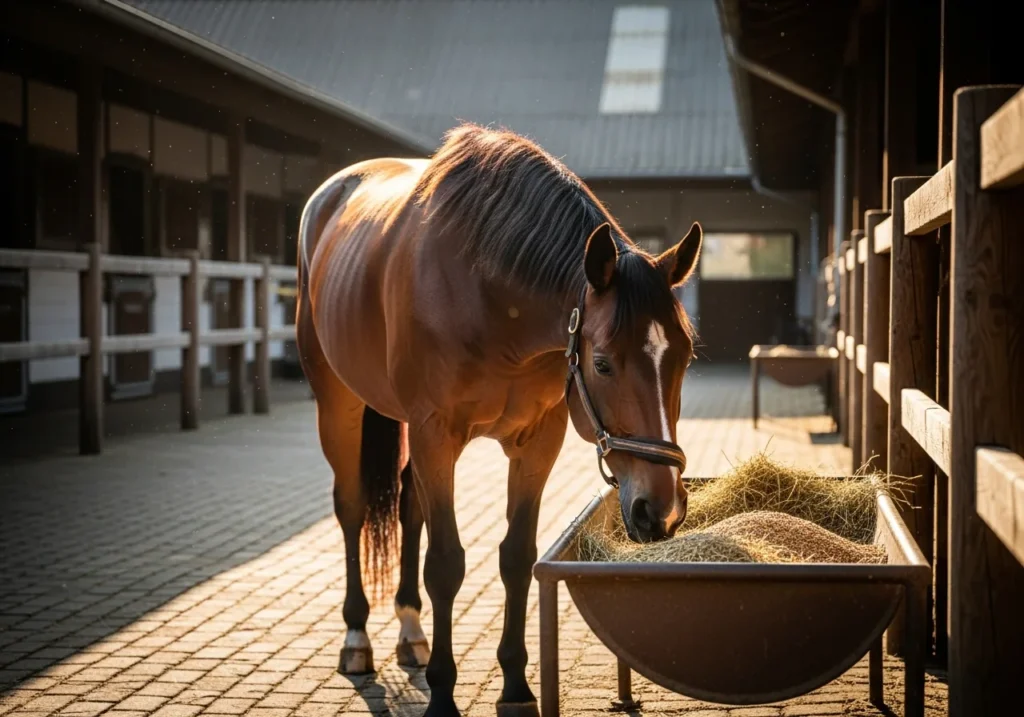
Feeding a horse well comes down to one core idea: forage first, everything else second. Horses evolved to graze almost continuously on grass, and their digestive system — a relatively small stomach paired with a long hindgut built for slow, steady fiber fermentation — works best when it’s never left empty for long. Getting feeding wrong is also one of the fastest ways to end up with a colic emergency, so it’s worth understanding the basics properly.
How Much to Feed
As a starting point, most horses need about 1.5–2% of their body weight in forage (hay or pasture) each day. A 1,000-pound horse, for example, needs roughly 15–20 pounds of hay daily if it’s not on pasture. This should be split across multiple feedings rather than one big pile — horses fed in long gaps are more prone to ulcers and colic.
Grain or concentrate feed is additional, not a replacement for forage, and should be scaled to workload. A horse in light riding work often needs little to no grain if forage quality is good; a horse in heavy competition work, a growing foal, or a senior horse with dental issues may need more calorie-dense feed.
Forage Quality Matters
Not all hay is equal. Good hay should smell fresh, be free of mold or dust, and have a reasonable leaf-to-stem ratio — too stemmy and it’s lower in nutrients, too fine and it may be overly rich for some horses. Pasture grass quality varies by season too; lush spring grass is high in sugar and can be risky for horses prone to laminitis or metabolic issues, and may need to be limited with a grazing muzzle.
Water and Salt
A horse can drink 5–10 gallons of water a day, more in hot weather or heavy work, and reduced water intake is one of the biggest colic risk factors. Free-choice salt (a salt block or loose salt) helps encourage normal drinking and replaces electrolytes lost through sweat.
Making Feed Changes Safely
Any change in hay type, grain brand, or turnout schedule should happen gradually over 7–10 days, mixing old and new feed in increasing ratios. Sudden switches disrupt the hindgut’s bacterial balance and are a well-documented colic trigger.
Supplements — When They’re Actually Needed
Most horses on good-quality forage and a balanced ration don’t need a long list of supplements. Common, genuinely useful additions include a vitamin/mineral balancer if forage quality is inconsistent, electrolytes for horses in heavy work or hot climates, and joint supplements for older or hard-working horses — ideally recommended by your vet rather than added speculatively.
For specific feed brand comparisons, see our Best Food for Horses buying guide.
Forage Comes First
Hay or pasture should make up the bulk of any horse’s diet — roughly 1.5-2% of body weight per day in forage, meaning a 1,000-lb horse needs about 15-20 lbs of hay daily if pasture access is limited. Grain and concentrate feeds are a supplement to forage, not a replacement for it; horses are designed to graze nearly continuously, and long gaps without forage access are a real risk factor for both colic and gastric ulcers, which are far more common in performance and stalled horses than most new owners expect.
Hay quality varies enormously. Look for hay that’s green (not yellow or brown, which signals age or poor storage), free of mold and dust, and appropriate to your horse’s needs — grass hay for most horses, alfalfa for those needing extra protein and calcium such as growing horses or heavy nursing mares. Always inspect a new hay batch before feeding a full ration.
Matching Feed to Workload
A horse in light or no work often does fine on forage alone plus a vitamin/mineral supplement or ration balancer. Horses in moderate to heavy work — regular riding, competition, or physical labor — usually need added calories from a concentrate feed to maintain weight and energy. Overfeeding grain to a horse that isn’t working hard is one of the most common owner mistakes, and it’s a real contributor to obesity, laminitis risk, and excitable, harder-to-handle behavior under saddle.
Body condition scoring (a 1-9 scale vets and experienced owners use to assess fat coverage over the ribs, neck, and tailhead) is a more reliable guide than weight alone, since ideal weight varies hugely by breed and frame.
Special Diet Considerations
Senior horses often need feed formulated for easier chewing and digestion as teeth wear down — soaked feeds or pelleted senior formulas are common solutions once a horse struggles with long-stem hay. Horses prone to laminitis or diagnosed with metabolic conditions like Equine Metabolic Syndrome need controlled sugar and starch intake, which means checking not just grain but pasture access and hay type — soaking hay can reduce sugar content for horses that need it. Always introduce any feed change gradually over 7-10 days — a sudden switch is one of the most common preventable causes of colic.
Water and Salt — Easy to Overlook
A horse drinks 5-10 gallons of water a day under normal conditions, more in heat or heavy work, and reduced water intake is a direct risk factor for impaction colic. Free access to plain salt (a salt block or loose salt) encourages adequate drinking and replaces electrolytes lost through sweat, especially important in hot climates or during heavy exercise.
Supplements — What’s Actually Worth Adding
Joint supplements (glucosamine, chondroitin, MSM) are among the most commonly used, particularly for horses in regular work or showing early signs of stiffness, though evidence for effectiveness varies by product and horse. Biotin supports hoof quality over months of consistent use, not overnight. Omega-3 fatty acid supplements, often from flax or fish oil, can support coat condition and have some anti-inflammatory benefit. Before adding anything, it’s worth asking whether a ration balancer already covers the gap — many owners stack supplements unnecessarily on top of a feed that’s already nutritionally complete.
Electrolyte supplementation matters most for horses in heavy work or hot climates who sweat significantly — plain salt access covers baseline sodium needs for most horses, but a working horse losing large volumes of sweat may need a dedicated electrolyte product to replace what’s lost.
Pasture Management and Grazing Risk
Spring pasture, especially after rain following a dry period, can be unusually high in sugars and a genuine laminitis trigger for sensitive horses. Grazing muzzles, limiting turnout to early morning hours (when sugar content is typically lower), or dry-lot turnout are all strategies owners use for horses that can’t safely have unlimited access to lush pasture. Rotational grazing — dividing pasture into sections and moving horses between them — also helps prevent overgrazing and parasite buildup in any one area.
Treats and What to Avoid
Carrots, apples (cut to avoid choking risk), and commercial horse treats in moderation are generally fine for healthy horses. Avoid feeding large quantities of any single treat, anything moldy, lawn clippings (which can ferment quickly and cause colic), and be cautious with treats for horses managing metabolic conditions, since even “healthy” treats like apples carry sugar that matters for a laminitis-prone horse.
Reading Hay Analysis Reports
Serious horse keepers, especially those managing horses with metabolic conditions, sometimes send hay samples for lab analysis rather than judging quality by eye alone. A hay analysis reports NSC (non-structural carbohydrate/sugar) percentage, protein, and mineral content — genuinely useful for fine-tuning a diet for a laminitis-prone horse or a hard-working performance horse where guesswork carries real consequences. Extension offices and specialized labs offer this service, usually for a modest fee.
Feeding Multiple Horses Fairly
In group turnout, dominant horses can bully others away from hay or feed, meaning a horse’s actual intake doesn’t always match what you put out. Spreading multiple hay piles (more piles than horses) and separating horses during grain feeding, even briefly, ensures each horse actually gets its intended ration rather than losing out to herd dynamics.
Working With a Feed Chart vs. Your Horse’s Reality
Feed bag charts give a starting range based on average horses, but your actual horse’s metabolism, workload, and body condition will pull that number up or down. Two horses of the same breed, weight, and workload can need noticeably different amounts — one running lean naturally, the other holding weight easily on less. Treat the bag’s chart as a starting point for the first few weeks, then adjust based on what you actually observe in body condition, not as a fixed prescription to follow indefinitely regardless of results.
A Final Word on Consistency
More than any single ingredient or brand choice, consistency in timing, amount, and forage access is what keeps a horse’s digestive system stable. Horses thrive on routine — the same feeding times each day, forage that doesn’t run out for long stretches, and changes introduced gradually rather than suddenly. If you take one habit from this guide, make it that one.
A Closing Thought
Good equine nutrition isn’t complicated in principle — quality forage first, calories matched to work, gradual changes — even though the details take time to master for your specific horse.
More Horses Guides
FAQ
Only if your horse needs the extra calories or nutrients — a horse in light work on good pasture often doesn't need grain at all. Overfeeding grain is a common cause of weight gain and metabolic issues.
Horses are designed to graze near-continuously. If pasture access is limited, hay should be available in multiple small feedings throughout the day rather than one or two large meals.
Sudden feed changes, low water intake, limited turnout, and moldy or poor-quality hay are among the most common triggers. Gradual diet changes and constant access to clean water reduce the risk significantly.
