

Hedgehogs roll into a ball as a built-in defense reflex — a ring of muscle around their body cinches shut and tucks their soft belly and face away, leaving only sharp quills facing outward. It’s an automatic response to feeling startled or threatened, not a sign of aggression or, on its own, a sign of illness.
If you’ve just brought a hedgehog home and it curls into a tight, spiky little ball the second you reach for it, don’t take it personally. It’s one of the most reliable things a hedgehog does, and it’s got nothing to do with you specifically — it’s just what hedgehogs are built to do when they feel unsure.
This reflex shows up across pretty much every species of hedgehog kept as a pet, and it’s been shaped by millions of years of evolution as a defense against predators far more dangerous than a curious new owner. Understanding what’s actually happening physically — and why — makes the whole behavior a lot less mysterious, and a lot easier to work with.
The Muscle That Makes It Possible
Hedgehogs have a band of muscle running around their body called the orbicularis, and it works a bit like a drawstring bag. When a hedgehog contracts it, the skin at the edges pulls together, tucking the head, legs, and belly inward while the quill-covered back wraps around the outside. The whole thing happens in under a second, and it’s not something the hedgehog has to think about — it’s reflexive.
Along with the muscle, hedgehog quills themselves are specialized, modified hairs, not barbed like a porcupine’s. They don’t detach and stick into a predator (or you) the way porcupine quills can — they’re simply stiff and sharp enough to make a rolled-up hedgehog an unappealing mouthful.

It’s Defense, Not Bad Behavior
It’s easy to read balling up as your hedgehog being difficult or unfriendly, but it’s really the opposite of aggression. A hedgehog rolling into a ball is choosing to avoid conflict entirely rather than confront whatever’s spooked it. Compare that to hissing, popping (a sharp jumping motion), or clicking, which are more active warning signals — balling is closer to a hedgehog simply opting out.
New hedgehogs, especially ones recently brought home, tend to ball up far more than settled ones. New smells, new sounds, and unfamiliar hands are all reasonable triggers. Most hedgehogs relax into handling gradually over days or weeks as the environment becomes familiar.
What Actually Triggers the Reflex
A few common triggers show up again and again with pet hedgehogs:
- Sudden movement or noise — even something as small as a door closing nearby
- Being picked up too quickly, without a chance to sniff and orient first
- Bright light, since hedgehogs are naturally nocturnal and light exposure can feel disorienting
- Unfamiliar scents on hands, especially after handling other pets
- General stress from a recent move, a cage cleaning, or a change in routine
Understanding the trigger usually matters more than trying to stop the behavior directly — a hedgehog that feels safe simply balls up less often over time.
How This Compares to Other Defensive Animals
Hedgehogs aren’t the only animal that curls up to protect itself, but the mechanics differ more than people expect. Armadillos use a similar rolling defense, but their armor comes from bony plates rather than muscle-driven skin. Pill bugs (often called roly-polies) roll into a ball too, though that’s an exoskeleton response rather than anything muscular. Porcupines don’t roll up at all — their main defense is the detachable, barbed quills themselves, which is also why they get confused with hedgehogs so often despite being completely different animals.
What makes the hedgehog’s version distinctive is how fast and complete it is — a genuinely startled hedgehog can go from fully stretched out to a tight, sealed ball in well under a second.
When Balling Up Becomes a Concern
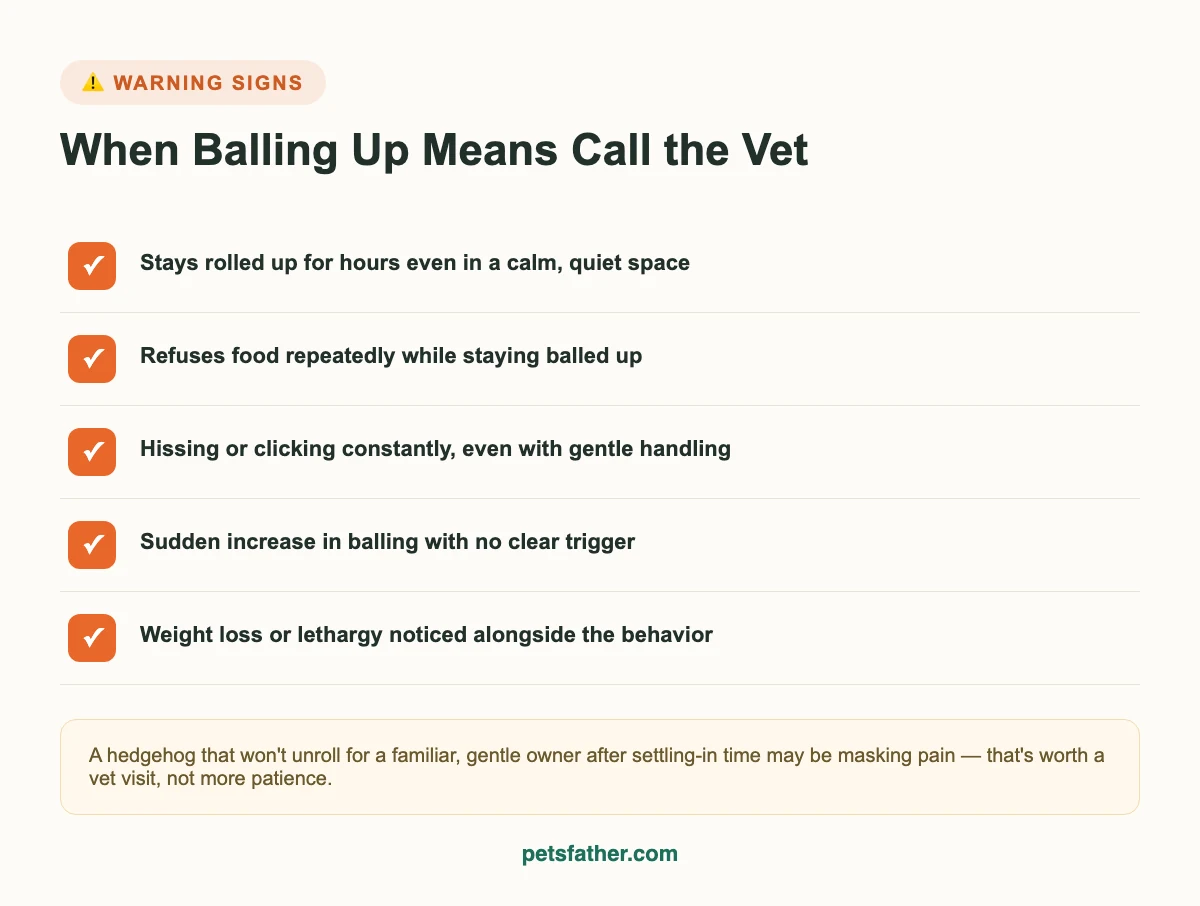
Occasional balling, especially with a new or shy hedgehog, is completely normal. A few patterns are worth watching more closely:
- Staying rolled up for hours at a stretch, even in a calm, quiet space
- Refusing food repeatedly while remaining balled up
- Constant hissing or clicking even with slow, gentle handling
- A sudden increase in balling with no obvious new trigger
- Weight loss or low energy alongside the behavior
Hedgehogs are good at masking discomfort, and an animal that’s genuinely unwell can hide behind balling up more than a healthy one would. If a normally-settled hedgehog suddenly starts balling constantly, that shift is worth a vet visit rather than waiting it out.
Helping a Hedgehog Feel Safe Enough to Uncurl
Settling in is usually a gradual process rather than a single breakthrough moment — most owners notice small improvements week over week rather than one day where the balling suddenly stops. A few things genuinely help a hedgehog settle and ball up less over time:
- Handle at their pace. Let them sniff your hand and emerge on their own terms rather than forcing an unroll.
- Keep handling sessions short and consistent, ideally around the same time each day so it becomes predictable.
- Use a consistent scent. Washing your hands with the same unscented soap each time can help a hedgehog recognize you faster.
- Respect their nocturnal schedule. Handling during their natural waking hours (evening) tends to go better than during the day.
- Keep the environment quiet and dim during interaction, especially early on.
Most hedgehogs do settle in with patience. If yours seems to be getting more defensive over time instead of less, that’s worth mentioning to an exotic-animal vet.
Do All Hedgehog Species Ball Up the Same Way?
Most hedgehog species share this defense mechanism, but not every species does it with equal enthusiasm. African pygmy hedgehogs — by far the most common pet hedgehog — are known for balling up readily as a first response to almost anything unfamiliar. Some individual hedgehogs within the species are simply more relaxed than others too, the same way some dogs are naturally more anxious than their littermates. Genetics, early handling experience, and simple personality all play a role.
Breeders and experienced owners often notice that hedgehogs handled gently and consistently from a young age tend to ball up less as adults, though it rarely disappears completely — it’s a hardwired reflex, not just a habit that can be trained away entirely.
What NOT to Do When a Hedgehog Balls Up
A few common reactions actually make things worse rather than better:
- Don’t try to force it open. Prying at a balled-up hedgehog usually increases stress and can occasionally result in a defensive nip.
- Don’t shake or jostle them. This can startle them further and reinforce that handling means danger.
- Don’t give up on handling entirely. Avoiding a hedgehog because it balls up often slows down the trust-building process rather than helping it.
The better approach is almost always patience — cupping them gently, staying still, and letting curiosity do the work once they feel safe enough to check out their surroundings. Many owners find that sitting quietly with a balled-up hedgehog resting in their cupped hands, without trying to interact at all, is often what breaks the ice fastest.
One More Thing to Watch
Context matters as much as the curling itself. A brief roll when you first reach into the cage and a hedgehog that stays balled up for hours, refusing food and water, are two very different signals — the first is normal caution, the second is worth a same-day vet call.
More Small Pets Guides
FAQ
Yes, this is very common in the first days or weeks after bringing a hedgehog home. Most hedgehogs relax and ball up less often as they get used to their new environment and owner.
They can feel sharp and uncomfortable, but hedgehog quills are stiff modified hairs, not barbed like a porcupine's — they don't detach or embed in skin the way porcupine quills can.
The best approach is patience — let them sit cupped in your hands in a quiet space and unroll on their own timeline rather than trying to physically pry them open, which usually increases stress.
Not typically — balling is specifically a defensive or startled response. A relaxed, content hedgehog is more likely to stay stretched out, walking around, or resting uncurled.
Changes to their familiar space and scent, plus the handling involved, are common stress triggers. This usually settles down once the cage smells familiar again.
No — hissing and popping are more active warning signals, while balling up is closer to a hedgehog withdrawing from a situation entirely. They can happen separately or together.
Not necessarily — some individual hedgehogs are simply more confident or bold than others. As long as they're eating, active, and otherwise behaving normally, a low tendency to ball up isn't a red flag on its own.
